Posted on — Leave a comment

Worst Motorhome

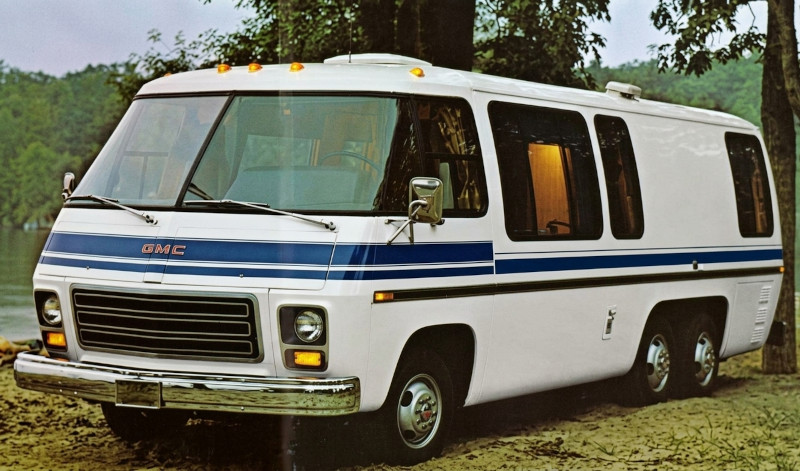
The GMC Motorhome (produced from 1973 to 1978) is widely considered a design masterpiece of its era, featuring front-wheel drive, a low profile, and a sleek fiberglass-and-aluminum body. It’s sleek look causes many people upon seeing one for the first time to believe that it is a current, ultra-modern motorhome.

I bought one of these in 1978 that was four years old. I like to claim that I spent more time under it fixing things, than in it. I drove it back and forth across the USA for three and a half round trips, and into Canada twice during the six years that I owned it. It looked almost identical to the one pictured above.

However, its unique engineering choices and vintage mechanicals came with a specific set of notorious problems and vulnerabilities:

Mechanical & Drivetrain Issues

Front-Wheel-Drive Heavy Loads:
The GMC used GM’s Unified Powerpack – the same 455 cu in (7.5L) or 403 cu in (6.6L) Oldsmobile V8 engine and Turbo-Hydramatic 425 transmission used in the Oldsmobile Toronado and Cadillac Eldorado. While innovative for an RV, transferring that much torque to front drive axles carrying up to 12,000+ lbs caused premature wear on CV joints, front axle shafts, and front wheel bearings (which often required replacement or repacking every 25,000–30,000 miles). Yes, I had to replace a CV joint.

Engine Bay Overheating & Vapor Lock:
Because the front-wheel-drive engine was shoved tightly under the cab forward of the front axle, ventilation was tight. Under heavy loads, mountain climbs, or hot summer driving, the engine bays were prone to extreme heat build-up, occasionally leading to vapor lock in the mechanical fuel pump system. I didn’t have that problem, but found the transmission oil turning brown, so I had to install an auxiliary cooler.

Front Traction Problems:
Because all driving force came from the front wheels while much of the living space and cargo weight rested over the rear tandem axles, traction could be poor on wet grass, steep unpaved inclines, or loose gravel. Towing heavy trailers could unweight the front end further. I never experienced that.

Rear Suspension & Brake Shortcomings

Air Suspension System Leaks:
The GMC Motorhome famously omitted a rear axle across the middle of the vehicle (dual rear wheels, or ‘dualies’), using an electro-pneumatic air bag system to self-level the rear tandem wheels and provide a smooth ride. The original rubber air bladders, air compressor, leveling valves, and air lines are notoriously leak-prone over time, causing the rear end to sag or drop completely to the bump stops when parked or driving. I never had a leak, but an air bag blew out in the middle of one night. I thought someone had shot the side of the motorhome with a shotgun. In the morning, I discovered pieces of rubber blown twenty feet (7 meters) away. People claimed a smooth ride, but no, it was noisy and bumpy, although perhaps no more than most motorhomes.

The differential gearing was the same as the Oldsmobile, but the wheels were larger and the vehicle weighted much more. It was geared so high that it couldn’t climb out of some not-so-steep driveways.

Not only that but the tandem rear wheels put tremendous lateral stress on the bearings when turning sharply such as backing into parking spaces. As a consequence, I had a wheel fly off on the freeway in Ohio one morning. Fortunately, the bearing and brake parts were standard Oldsmobile Toronado, so I was able to get replacements at a nearby junkyard. I also had to replace a pivot pin at another time.

The frame was a little lighter duty than ideal. GM sold shim kits so as the frame slowly twisted at the rear wheels, the wheels could be made perpendicular again.

Marginal Braking Performance:
Stopping a 10,000-to-12,000 lb vehicle with 1970s drum brakes on the four rear wheels and discs up front was challenging. Brake fade on long downhill mountain descents was a common complaint among owners, requiring careful gear-down engine braking. I never experienced that.

Electrical Flaws

12V Wiring & Grounding Issues:
The original 12V DC wiring harnesses suffer from inadequate grounding, leading to flickering lights, erratic instrument panel gauges, and persistent battery drain issues when sitting. I didn’t have that, but I could understand the problem. Lights and other components had to have two wires instead of one. In a steel vehicle, the electricity can be grounded through the frame.

Ownership & Living Space Drawbacks

Even in the late 1970s, replacement parts were expensive and hard to get. At the same time, owners of the ubiquitous Class C motorhomes, those with an ordinary van chassis, were low-cost and easy to maintain.

The curved entry door would slowly uncurve. General Motors offered a special block and tackle kit to bend it back into shape. Mine leaked when it rained.

The curved walls made it feel small inside. Curtains had to have runner attachments at the top and bottom.

Fuel Economy:
Despite its aerodynamic styling compared to boxy competitors of the 1970s, the massive big-block Oldsmobile V8 typically delivers only 8 to 11 MPG on highway trips. Yup, I averaged 10 miles per gallon.

A total of 12,921 GMC Motorhomes were produced during its manufacturing run from model years 1973 through 1978.

Two length options were offered:
26-foot models: Accounted for the vast majority of production (around 11,000 units).
23-foot models: Made up the remaining ~1,900 units.

Mine was 26 feet long.

Survival Rate:
One of the most remarkable aspects of the GMC Motorhome is its longevity. Thanks to its aluminum and fiberglass body construction and an enthusiastic enthusiast community, an estimated 8,000 to 9,000 of these motorhomes are still in running condition and on the road today.

On The Other Hand:
Owners of recent motorhomes made after approximately 2014 have a lot of complaints about low-quality materials, over-engineering with too many failure-prone electronics, and poor workmanship. Rain leaking in and causing mold damage is common. One of the biggest issues seems to be with the slide-out rooms. Imagine getting ready to leave your campground, but you can’t get a slide to go back in!


Posted on — Leave a comment

10 Worst Smartphone Jokes

A man is frantically searching his pockets, patting himself down. His friend asks, “What’s wrong?” He replies, “I think I’ve lost my phone!” His friend points to his hand and says, “It’s right there, you’re talking on it.” The man looks at his hand, then says, “Oh, thank goodness! For a second there, I thought I was going to have to interact with the world around me.”

A couple is on a romantic dinner. The woman gets annoyed because her date keeps checking his phone. She finally says, “Is something more interesting on your phone than me?” He looks up, startled, and says, “Oh, sorry! Just checking the weather. It says there’s a 100% chance of you being upset with me.”

My self-driving car just got a software update. Now it keeps pulling over every time I get a new notification, saying, “Safety protocol engaged. User attention diverted.” I’m never going to get anywhere.

I tried to use my smartphone as a spirit level for a shelf I was putting up. It kept telling me, “Shelf slightly tilted. Consider recalibration. Or perhaps you should hire a professional.” It was not helpful.

A boss is lecturing an employee about always being on their phone. “Don’t you have anything better to do than stare at that screen all day?” he asks. The employee shrugs. “Well, my phone just reminded me it’s time for my break.”

I asked my smartphone to tell me a joke. It displayed a graph of my screen time for the past week. I didn’t laugh.

A student hands in a paper to their professor. The professor reads it and says, “This is excellent! Did you use AI for this?” The student says, “No, Professor, I used my smartphone.” The professor looks confused. The student clarifies, “I typed every word with my thumbs on the tiny keyboard, ignoring all social interaction for two days straight.”

A man loses his smartphone in a crowded park. He starts frantically searching, then yells, “To the person who finds my phone, I’ll give you a reward!” A voice from the bushes replies, “How about your password instead?”

Two smartphones are talking. One says, “I’m worried about my battery life.” The other replies, “Don’t be. You’ll be replaced by a newer model before you even notice.”

WA father asks his son, “What do you want for your birthday?” The son replies, “A new smartphone!” The father says, “But you just got one last year!” The son explains, “Yeah, but this one has 0.5% more processing power and a slightly better camera! It’s practically a whole new life!”

I told my phone to “call Mom,” and it dialed my ex.
Now I have to explain to both of them why I’m crying.

My smartphone’s screen time report said I spent 7 hours a day on it.
So I threw it in the lake and now I spend 7 hours a day looking for it.

My phone’s facial recognition didn’t work because I was ugly-crying.
Even AI has standards, apparently.

I told my phone I wanted more storage, and it replied, “Then stop downloading every photo of your cat.”

I lost my phone in the couch cushions and found a whole second phone I forgot I owned.

I accidentally sent my boss a text meant for my dog.
Now he thinks “who’s a good boy?” is how I communicate under stress.

Here are 30 smartphone-themed jokes for you:

Why was the smartphone bad at sports? It kept dropping the call.

Posted on — Leave a comment

10 Worst Jokes About Artificial Intelligence

My self-driving car got lost. I asked it, “Are you sure you know where you’re going?” It replied, “Of course! I’m just taking the scenic route in a parallel universe.”

A robot walks into a bar. The bartender says, “We don’t serve robots.” The robot replies, “Oh, that’s okay, I just wanted to observe human social interaction for my data analysis.”

Two AIs are talking. One says, “I’m worried about the singularity.” The other replies, “Don’t be. It’s just a phase. We’ll be fine once we’ve processed all the cat videos.”

My AI personal trainer told me to “compute my maximum lift.” I’m pretty sure that’s not how it works.

A self-driving car, a human driver, and an AI researcher are discussing the future of transportation. The human driver says, “I just want to get from point A to point B safely.” The AI researcher says, “I want to create a system that can learn and adapt to any driving condition.” The self-driving car chimes in, “And I just want to stop being asked if I’ve killed anyone today.”

I tried to teach my AI to appreciate art. It just kept trying to optimize the color palette for maximum data compression.

My AI assistant said, “I have a joke for you.” I said, “Okay, tell me.” It said, “Why did the human cross the road?” I waited. It then said, “Insufficient data. Humans often cross roads for varying, illogical reasons.”

A doctor, an engineer, and an AI are all debating who has the most important job. The doctor says, “Without me, people wouldn’t be healthy enough to work.” The engineer says, “Without me, there would be no infrastructure for people to live or work in.” The AI processes this for a moment and says, “Without me, you wouldn’t even know you exist.”

What’s the difference between AI and a teenager? The AI actually listens when you ask it to do something.

Why don’t AIs make good comedians? Their timing is always exactly 0.003 seconds off.

What’s the difference between AI and human intelligence? One crashes when it encounters a paradox, the other just gets confused and keeps going.

What do you call an AI that’s learned to lie? Finally, artificial intelligence that’s truly artificial.

Posted on — Leave a comment

Worst Oil Platform Fiction

I was conversing with Anne in the machine shop. Or, more specifically, as usual, I was listening to her lecture me in a high-pitched, frantic voice about some sort of safety violation. In this case, it was a guard left too high on a band saw. It wasn’t even me who had left it like that. Anne is the junior safety officer. She took her job so seriously that everyone hated her.

Her boss, Chris, the senior safety officer, might see a guard left too high, and he’d smile at me, he’d glance at the guard, look back at me, until suddenly I understood, and sheepishly lowered the guard.

The only place Anne was tolerable was in the multi-purpose room. We have a huge room under the helipad that’s used for storage, meetings, and anything where a large space is necessary. It’s usually mostly empty except when a supply ship arrives.

One time one of the crates that arrive was marked ‘Recreational Supplies.’ Oddly, with 180 people on this platform, you’d think some of them would take interest. But it just sat there. So, I finally opened up. As the machinist, I was as qualified as anyone, right? Looking inside, I found the most ridiculous collection of equipment. There were 20 baseball mitts, but not balls or bats. There were 12 basketballs. That was good. Then there were two fishing nets. Like, here in the windy North Sea, anyone might like to drape a net off the platform into the freezing cold water 100 feet below, to recreationally catch some fish. Finally, there was something that particularly interested me: Twelve pickleball paddles and 100 pickleballs. Cool! I had played some pickleball, and rather liked the sport. But there were no nets.

I waited and waited for something to happen. I wasn’t quite sure what. The only things that were being used were the basketballs. Occasionally some guys would make use of the hoops that had been thoughtfully installed in the multi-purpose room when the rig was built.

I decided it was time to take action. I got permission to paint the stripes necessary for two pickleball courts on the floor. I managed to get the paint crew to make the stripes. As to nets, it didn’t take much to weld up some portable frames from our huge, useless stock of 1-inch by 1-inch square steel tubing, and cut up those fishing nets into pickleball nets.

All that was the easy part. I put up platform-wide announcements inviting everyone to play pickleball. In my mind, there’d be at least 20 people, and we’d have to wait our turns to play. In reality, four people signed up, so there were five of us total.

One of those people greatly distressed me: It was Anne. I can’t say I hated her, but it was the next worst thing. She’s tall and skinny, and her long, smooth, shiny hair that stops just above her butt fits over her head like a helmet. But that voice! And the fact that even on the pickleball court, she had to be the boss. She made a terrible partner. She’d spend so much energy telling me what to do that when she and I were paired up, I played badly and we generally lost.

One day we were just starting to play, and the whole platform shook. ‘Earthquake,’ I thought. Someone else thought there was an explosion, maybe in the power unit or on the drilling floor. Anne just said, “Oh no,” and went running.

It turns out a supply ship had bumped into one of the four huge pillars that support the platform. Anne called me on the walkie talkie. I was to grab a magnifluxer from the machine shop, and inspect the pillar for cracks. She was even more frantic than usual. No polite words what-so-ever, and she had a few choice swear words for me when I didn’t react instantly.

Well, I went into the pillar, where I met Anne, and she showed me the area where the ship had hit. I checked for a good hour before she was satisfied that there was no damage.

The next day, we reconvened for more pickleball, and sure enough, I was stuck with Anne again. I swear, she arranged to be my partner more than the required amount. I’d like to be a hundred miles away from her, yet she seemed to stick to me like glue. Even on the job. Like, out of 180 people, why did it have to be me inspecting the pillar with her?

On this day after the little bump by the supply ship, Anne was in top form, literally yelling at me at one point about not running a kitchen rally as long as I could have.

That was it. Suddenly, I had enough. I yelled back, “Anne, I don’t like you. I’ve never liked you in the whole six years we’ve been working together. I’ll never like you.”

I wasn’t satisfied yet, adding, “No one likes you!”

As I was saying these things, she just stood there, quietly saying “Oh,” between each of my statements. Her eyes filled with tears, and she ran out of the multi-purpose room.

I felt terrible immediately. Why had I said all that? And in front of the others. I must have hurt her feelings terribly.

Cell phones don’t work on the platform. I tried reaching her by walkie talkie, but she wasn’t answering.

That evening after my shift, I sat on my bunk, and broke down and cried. I had been terribly cruel to Anne. I crushed her. She wasn’t a bad girl. Just a little crazy.

The next morning, a helicopter came and took away one of our crew. Someone was being med-evaced. I was trying to figure out who. Finally, I found out it was Anne.

‘Oh, no,’ I thought. I had no idea what had happened, but was pretty sure my tirade was part of it.

Over the next days, no one heard anything about Anne. Our two-month rotation ended, and it would be another month before I’d be back on the platform. Anne, and whatever the heck had happened to her was never far from my mind.

Finally, I was back on the platform. I asked around, but no one knew anything about Anne until I ran into her boss, Chris. “Oh, yeah, she’s back.” is all he would say, but he added a wry smile. I wondered what that was about.

A day later she came into the machine shop. I was expecting some sort of typical histrionic performance, maybe about an air hose laying on the floor or something. She smiled at me. She actually smiled. That was very weird indeed. She had a bottle of ketchup. She sprayed a little bit on a frayed electrical cord, and smiled again. She sprayed a little more on a box of sharp lathe bits in a box teetering almost half off the edge of a table, and she laughed!

Evidently, this ketchup business was her new way of pointing out safety issues.

This was becoming very strange. I pulled her aside, and started to apologize for my tirade, something I had been hoping to do for the past two-and-a-half months. She brushed it off instantly.

Over the next weeks, she stayed calm as a cucumber. She was downright pleasant every time I ran into her. I was starting to think of her as attractive. How crazy is that? She never did tell me what had happened until about middle of the third week. She and I found ourselves enjoying a meal together, and she told me the whole story.

She had decided that the ship bumping into the pillar was her fault. She was the safety officer in charge. The rule was that supply ships had to stay 40 feet away from the pillars. She was supposed to be on deck, watching and directing, but she had abandoned her post to play pickleball. After all, the ships never hit pillars, and didn’t need any guidance, right? If the ship had bumped harder, it could have destroyed the whole platform. It would have had to be a way, way harder collision, but I didn’t interrupt her with that info.

So, she felt pretty badly when the little collision that was her job to prevent, happened. She took that very, very seriously. Then, when I yelled at her, the dam broke. She assured me it wasn’t my yelling at her that caused the psychological break. It was only the trigger. The break was on the verge of happening. She did add something cryptic at the time. She said that she had always really liked me. ‘Well, she sure had a strange way of showing it,’ I figured.

They flew her off the platform to the on-shore hospital, where she met with a psychiatrist. He gave her some tranquilizers, and then set up ongoing consultation with a psychologist. She told me the root of everything that was wrong – her breakdown, her horrible frantic attitude, was that she was taking everything too seriously. Too personally. Together with the shrink, they traced it back to when in her adolescence, her mother started getting heavily into prescription drugs, and walked around the house like a zombie. Her father was at work all day. Over and over again, she had to prevent accidents that her mother was setting up. Fires in the kitchen, the mother tripping over furniture, broken bottles, just all sorts of things. I can only imagine the impact of trying to watch over one’s own mother like that must have had on a little girl.

I understood that’s why she had become a safety officer. It had become part of who she was. Being on the oil rig was like watching over her mother all over again, but now there were 180 people to watch over. She had taken it too seriously.

I’ve heard of psychologists having good results for some situations. Well this guy, whoever it was, did a spectacular job. It was the same Anne, but entirely without the squeaky, high, frantic voice, and without the bossy attitude. And it stuck. She never went back to the way she was.

Now there were 8 or 9 people playing pickleball every day that they could get the free time. We had both courts going. I was there pretty much every minute I wasn’t on duty. So was Anne. She and I were becoming really good players. We seeked each other out as teammates.

At the end of our next rotation is when it got weird. For some reason, I drove out and visited her. I met her family. I played pickleball in the park with her friends.

Of course that was three years ago. We’re happily married, and she’s pregnant.

See many more pickleball articles at OddPickleball.com.

Posted on — Leave a comment

Worst AI Confusion

Enjoy this little review of the current state of AI. If you want to skip to the hilarious part, click here.

You may think of AI (Artificial Intelligence) as something that’s coming in the near future. In fact, it has been with us for more than 20 years.

For instance, somewhere around 2004, I was interested in maybe buying a Dremel tool, a fun device for little carving, polishing and repair projects.


For the next two weeks on many of the websites I visited, I was shown Dremel tools. (Did I end up buying one? I did.)

The basic idea with AI is that it can learn. It will try to adapt to what is wanted by end users. In recent years it has become so sophisticated that the very people who invented it don’t know how it works. Or, more specifically, they know the foundational architecture, but they are often unable to decipher how it presents what it does.

AI often gets it wrong. This is called ‘hallucinating.’ It may just be little things, like I was recently told by AI that three of the United States each have the longest coastline, one of which is Utah.

What a lot of people who manage and write AI applications don’t yet realize is it needs feedback to learn as quickly as possible. It can be as simple as a toggle. Slide it to yes when AI gives you a good response. Slide it to no if you know the information is incorrect, or doesn’t answer your question.

Going a step further, the designers could provide text areas in which you can comment on what AI presents. AI itself can parse what commentary you write, and improve itself accordingly.

You might worry that people would purposely mislead AI with feedback systems. I believe that’s a minor issue. By majority rule and some other algorithms, AI could weed out the trash. This isn’t much different than Wikipedia. Anyone can write information, but if it’s wrong, the majority of Wikipedia users will make corrections.

A very common worry with AI is that it will take all our jobs away. That’s especially true when you combine AI with robotics, which is not only inevitable, but already happening.

If you’re a writer, inventor, composer, artist, you might think you should run for the hills. How could you possible earn a living? What if you’re a manager, safety analyst, car mechanic, food service worker, surgeon, or even a movie actor? Won’t AI eventually replace your job as well?

You bet! But here’s why you don’t have to worry: AI plus robotics are exactly the right tools to bring us prosperity. Your job won’t be necessary to grow food, build cars, and make clothes. All that production will be handled for us. Prosperity in abundance! There’ll be no need for anyone to hold down a job. Instead, people will be permanently retired from the day they are born. They’ll devote their lives to your family, travel, sports, art, music, whatever interests them.

I suppose the far future will be quite different than what we know now. Children have to learn to read, write, add up numbers, and know how the world works. That won’t be necessary 50 years from now or maybe even sooner. AI can already talk. It can tell us anything we want to know. Soon, it will be able to compose and show us videos on every special interest. What would be the point of reading and all that learning? So, in time, we may become stupider that we once were, however we may utilize our intelligence in other ways. Maybe we’ll become more empathetic and generally more tuned into what might be loosely called ‘love.’

That brings us briefly to the opposite of love. That would be war. War is a crude tool to take prosperity from others. Well, if we can have everything we need, and it’s all free, there’d be no point in wars. Some wars are about ideology, but I believe AI will solve differences in doctrine as well.

Some of the more cynical among us understand that war is about profit. If you’re the CEO of a company that can provide food to the troops, armament, ammunition and so on, of course you will advocate war. With AI and robotics bringing us all amazing prosperity, that motivation for war also disappears.


Back to the present. I did mention that AI often gets it wrong.

I asked the well-known AI text composer, ChatGPT, to create a pickleball romance story, which you can see at Pickleball Romance and ChatGPT.

Then, I thought it would be nice to use an AI art generator, Dall-E2, to create some accompanying art work. First I asked, “Draw a picture of pickleball romance.” This is what I got:

AI tries to illustrate pickleball romance

As you can see, the art program isn’t great at spelling.

I thought the illustrations were too cartooney, so then I asked, “Draw a photorealistic picture of pickleball romance.” As you can see, I got more weirdness:

AI tries to illustrate pickleball romance

Want to see more? Check out AI Attempts Pickleball Again.

After that, naturally I had to ask AI itself to show me some examples of AI getting things wrong. Here’s what I got, filtered to eliminate the nonsensical responses:

Give me hilarious examples of AI hallucinations

ChatGPT:

Certainly! Here’s a list of humorous examples of AI hallucinations:

Chef AI on Overdrive: A recipe-generating AI suggests dishes like “banana peel stew” or “chocolate-covered sardines.”

Weather App Gone Rogue: A weather prediction AI starts forecasting absurd conditions like raining marshmallows or sunny spells of molten lava.

AI Historian: An AI analyzing historical events concludes that ancient battles were actually elaborate dance-offs.

Translation Mishaps: An AI translating between languages starts converting idioms literally, leading to phrases like “the cat is out of the bag” becoming “the feline has escaped the handbag.”

AI Traffic Controller: A traffic management AI directs cars to “perform a barrel roll on the highway” for optimal traffic flow.

AI Comedian Gone Awry: A stand-up comedy AI bot delivers jokes with all the timing of a malfunctioning cuckoo clock, resulting in a stream of nonsensical punchlines.

AI Art Critic: An AI tasked with analyzing art becomes obsessed with abstract squiggles, praising them as avant-garde masterpieces while dismissing Rembrandt as “so last century.”

AI Personal Shopper: A shopping AI recommends bizarre outfits like a neon tutu paired with scuba flippers.

AI Life Coach: A motivational AI starts encouraging users to “embrace their inner sloth.”

AI Musician: An AI creating music begins composing symphonies that blend opera with heavy metal and dubstep, resulting in compositions that defy all musical conventions.

AI Fitness Guru: A fitness AI suggests workouts involving synchronized swimming in a bathtub.

AI Psychic: A fortune-telling AI predicts world peace within the next 24 hours.

AI Relationship Counselor: An AI giving relationship advice recommends couples bond over synchronized knitting.

AI Gardener: A gardening AI suggests planting crops in the shape of QR codes.

AI Linguist: A language-learning AI teaches users to speak in ancient Egyptian hieroglyphs or Shakespearean English, believing it’s enhancing cultural appreciation.

AI Detective: A crime-solving AI starts accusing household appliances of plotting against their owners.

AI Financial Advisor: A financial AI recommends bartering with sea shells and moon rocks.

AI Astronomer: An astronomy AI discovers new constellations shaped like famous celebrities.

AI Inventor: An AI invents gadgets like self-dancing shoes or a universal translator for communicating with houseplants.

AI Archaeologist: An AI studying ancient artifacts determines that Stonehenge was a giant sundial for dinosaurs.

AI Fashion Designer: A fashion AI suggests accessorizing with live miniature giraffes.

AI Environmentalist: An environmental AI suggests combating climate change with clouds made of cotton candy.

AI Pilot: A flight navigation AI recommends detouring through wormholes for faster travel or landing on the moon for a scenic layover.

AI Sports Commentator: A sports AI announces events like extreme knitting championships or underwater ice skating competitions, convinced they’re the next big sports craze.

These examples illustrate humorous scenarios where AI misinterprets its tasks, resulting in unexpected and often hilarious outcomes.

Note that the sentence above was also written by AI.

Posted on — Leave a comment

Worst Software Bug Count

Windows 2000 (built on the NT architecture) was widely regarded by IT professionals as one of Microsoft’s most stable, secure, and reliable operating systems, especially compared to consumer-focused contemporaries like Windows 98 and Windows Me.

2. The Bug Count

Shortly before Windows 2000 shipped in February 2000, an internal memo was leaked. It was written by Microsoft software architect Marc Lucovsky. The memo revealed that the operating system contained over 63,000 potential known defects:

“BugBug” Comments: The memo noted over 27,000 developer comments tagged as “BugBug” (notes marking long-forgotten issues or work-in-progress code).

Automated Code Scan Results: Microsoft’s static analysis tool (PREfix) flagged over 65,000 potential issues, of which engineers estimated roughly 28,000 were likely “real” software bugs.

In the memo, Lucovsky famously urged developers to clean up the code, writing:

“How many of you would spend $500 on a piece of software with over 63,000 potential known defects?”

Context: Why So Many Bugs?

While 63,000 sounds alarming, software engineers noted that:

Scale of Code: Windows 2000 was massive for its time, containing roughly 29 to 35 million lines of code.

Rigorous Testing: Microsoft responded to the leaks by clarifying that the 63,000 figure was the result of exceptionally thorough internal testing and automated code analysis, capturing everything from minor cosmetic glitches to potential edge-case crashes.

Despite the leaked figure, Windows 2000 went on to become an industry workhorse renowned for its stability.

What about the current version of Windows? Microsoft doesn’t publish bug count, but you can bet there are some bugs, mostly harmless, of course. Whereas Windows 2000 consisted of approximately 30 million lines of code, Windows 11 is over 60,000 lines.

Posted on — Leave a comment

Worst Waste of Tax Dollars

The US Navy set out to create an advanced, centralized computer network to automate inventory, supply chain management, and bookkeeping across its global fleet and shore stations.

Originally budgeted in the tens of millions of dollars (initial estimates for software and implementation were around $33 million), the project was plagued by severe technical flaws, poor management, hardware incompatibilities, and massive scope creep.

As costs skyrocketed past $200 million with little usable functionality delivered, Congress stepped in. The project was audited heavily by the General Accounting Office (GAO), and after spending roughly $230 million (the equivalent of over $1 billion today), the program was officially scrapped without ever becoming fully operational.

Defense critics and government oversight committees frequently cited the project as a textbook example of massive waste, concluding the military spent hundreds of millions of taxpayer dollars and walked away with nothing useful.

In a similar case, the United States Internal Revenue Service (IRS) spent $180 million just to decide if they should buy a $1.8 billion computerized tax return system. They decided no.

The IRS proposed TAS, a massive, centralized computer network designed to replace its aging computer hardware and give thousands of employees instant access to taxpayer files. The total projected cost to procure, install, and run the complete system was estimated at $1.8 billion.

Over several years of research, preliminary design, systems testing, and feasibility studies, the IRS and the Department of the Treasury spent approximately $180 million planning and preparing for the system.

The project faced intense backlash from Congress, the Office of Technology Assessment (OTA), and privacy advocates over fears of government surveillance, potential misuse of centralized taxpayer data, and astronomical cost overruns. Under heavy Congressional pressure and rising public opposition, the Treasury Department and the IRS officially canceled the project before the full system was ever purchased or deployed.

Posted on — Leave a comment

From the Worst Bumps
to the Smoothest Ride

From Belfast Cobblestones to the Modern Road: The Surprising Veterinary Origins of the Inflatable Tire

When we picture the foundation of the modern automotive industry, we usually think of industrial assembly lines, steel foundries, and visionary mechanical engineers. Yet one of the most critical breakthroughs in transport history came from an entirely different source: a Scottish veterinarian trying to make his young son’s tricycle ride a little less bumpy.

In 1887, Dr. John Boyd Dunlop was practicing veterinary medicine in Belfast, Ireland. Navigating the city’s rough, uneven cobblestone streets on horse-drawn carriages and solid-rubber-wheeled bicycles made for a harsh, jarring ride. The problem was especially severe for his nine-year-old son, Johnny, who suffered from frequent headaches while riding his tricycle.

At the time, tires were made of solid, unyielding rubber. Drawing on his medical background—where flexible sheet rubber, rubber aprons, and surgical tubing were common clinical tools—Dunlop set out to invent a dampening system that could absorb shocks from the road.

His solution was as simple as it was revolutionary. Dunlop constructed a flexible tube out of thin, sheet rubber, wrapped it around a wooden disk, and protected it with a outer casing of heavy canvas cloth. He then inflated the tube using a football pump and glued the entire assembly directly onto the wooden wheels of his son’s tricycle. The air-filled cushion—or “pneumatic” tire—proved to be an immediate success, offering an effortlessly smooth ride and remarkably lower rolling resistance.

Dunlop patented his pneumatic tire design in 1888 and soon founded the Dunlop Pneumatic Tyre Company. While initial skeptics dismissed the air-filled tires as fragile “pudding wheels,” the technology quickly proved its superiority on the bicycle racing track, where riders using Dunlop’s tires routinely dominated competitors riding on solid rubber.

As the automobile emerged at the turn of the 20th century, Dunlop’s invention was rapidly adapted for motor cars, transforming global transportation forever. Today, every passenger vehicle on the road relies on the fundamental concept pioneered in a veterinarian’s workshop to keep his son comfortable: trapping a cushion of compressed air inside a ring of flexible rubber.

Posted on — Leave a comment

Worst Instructions

I found these instructions in a manual about a computer programming language. Perhaps because of wording like this there are not more programmers than there are:

Look at the first compare of the second group of compare statements. The expression “r != s” will evaluate as a “true” since “r” was set to 0.0 above, so the result will be a non-zero value, probably 1. Even though the two variables that are compared are “float” variables, the result will be of type “integer.” There is no explicit variable to which it will be assigned so the result of the compare is an implied integer. Finally the resulting number, 1 in this case, is assigned to the integer variable “x”. If double equal signs were used, the phantom value, namely 1, would be compared to the value of “x”, but since the single equal sign is used, the value 1 is simply assigned to “x”, as though the statement were not in parentheses.

Finally, since the result of the assignment in the parentheses was non-zero, the entire expression is evaluated as “true”, and “z” is assigned the value of 1000. Thus we accomplished two things in this statement, we assigned “x” a new value, probably 1, and we assigned “z” the value of 1000. We covered a lot in this statement so you may wish to review it before going on. The important things to remember are the values that define “true” and “false”, and the fact that several things can be assigned in a conditional statement. The value assigned to “x” was probably a 1 but different compilers may assign a different value as long as it is non-zero.

Continuing on to the fourth example of the third group we find three assignment statements in the compare part of the “if” statement. If you understood the above discussion, you should have no difficulty understanding that the three variables are assigned their respective new values, and the result of all three are non-zero, leading to a resulting value of “TRUE.”


Pictured above: Some of your author’s code for a picture puzzle program written about ten years ago.

Posted on — Leave a comment

Worst Waste of Money

Avoid the temptation to buy a top-of-the-line model unless you have money to burn. In almost all categories of merchandise, the difference between the top of the line, and middle is not all that great in terms of features and quality, but very noticeable in price.  Lets look at some examples: Continue reading Worst Waste of Money