Posted on — Leave a comment

10 Worst Bicycle Jokes

Why did the bicycle fall over? Because it was two tired!

My bike mechanic told me I needed new brakes. I told him, “No breaks! I’m on a tight schedule!”

Why did the bike go to therapy? It had too much chain anxiety.

A cyclist is pulled over by a police officer. The officer says, “Sir, do you know why I pulled you over?” The cyclist replies, “No, officer, I don’t. Was I going too fast?” The officer sighs, “No, you were riding with no hands, no helmet, and you were juggling flaming torches. And you had a parrot on your shoulder yelling obscenities.” The cyclist shrugs, “Well, I was just trying to have some fun!”

I joined a cycling club. The welcome packet included a waiver, a map, and a tube of chamois cream.
I’m still not sure if I joined a sports club or a cult with suspiciously smooth thighs.

I went on a blind date with a cyclist.
Everything was going great until she said, “I only date people who can hold 22 mph on a climb.”
I said, “I only date people who believe in gravity.”

Why did the bicycle break up with the treadmill?
Because it couldn’t handle a relationship that went nowhere.

I asked my date if she wanted to go tandem biking.
She said she preferred relationships where one person wasn’t doing all the work.

My bike has more gear than I do.
Seriously, it’s got 21 speeds, disc brakes, and electronic shifting.
Meanwhile, I’m riding in gym shorts and praying I remembered deodorant.

My bike got stolen last week.
The thief left a note: “Sorry, but this ride deserved better than you.”

Cyclists are like cats.
They’re sleek, independent, occasionally hissy, and when they fall, they pretend it was on purpose.

My friend bought a $5,000 bike and now rides 3 miles every other Sunday.
At that rate, he’ll break even sometime in the 28th century.

I got pulled over on my bike for speeding.
I asked the cop if I was really going that fast. He said, “No, but your outfit is a crime.”

I tried group riding, but the only thing I learned was how to apologize while gasping,
“Sorry… can’t keep up…”

My bike is like my therapist.
It listens without judgment, supports me when I’m down, and lets me scream into the wind without anyone calling the police.

I asked a cyclist how long it takes to get used to the saddle.
He said, “About six months. Then the numbness becomes part of your personality.”

You know you’re a cyclist when your tan lines look like you fell asleep in a cage.

My kid asked why I ride my bike so much.
I said, “Because it’s the only time I can hear my own thoughts.”
He said, “That’s sad, Dad.”
I said, “I know. Now go fetch my helmet.”

What do you call a cyclist who doesn’t wear a helmet? An organ donor.

What do you call a bicycle built by a chemist? Bike-carbonate of soda.

Why did the cyclist bring a map to the velodrome? He kept going in circles.

What’s the difference between a cyclist and a fish? One has scales, the other has wheels.

Posted on — Leave a comment

Worst Way to Ride a Bicycle

Wrong Way Wooten,
World’s Most Eccentric Bicycle Tourist

Copyright 2014-2026, Jeff Napier

You may occasionally hear someone refer to doing something oddly, or backward, as “Wrong Way Wooten.”
This has become an expression almost entirely detached from its roots. Something like, “Who is John Galt?” That came from the classic novel, Atlas Shrugged, by Ayn Rand. But what about “Wrong Way Wooten?” What’s that all about?

In approximately 1955, Tom Wooten was born in Bryn Mawr, Pennsylavnia.

This place with the weird spelling (pronounced “brin mar”) is approximately eleven miles outside of Philadelphia. Bryn Mawr means “Big Hill” in Welsh. This is a little town of approximately 4,000 people with a neat little downtown where most of the buildings, and most homes, are made of red or orange brick. Bryn Mawr is known as one of the wealthiest areas in the United States, and that figures into our story later on. Ten percent of the population is black, ten percent Asian, and the rest mixed or white.


Bryn Mawr in Pennsylavania


Downtown Bryn Mawr

Tom grew into a tall, slim, very dark skinned, strong, good-looking man. For a short while in the 1980s, he was slightly world-famous. He did not attain the level of celebrity such as Paul McCartney, Dolly Parton, or Burt Reynolds, but he did become a legend, and I think you’ll agree that what he did was significant.

So what did he do? He rode a bicycle backward. That’s all. But he leveraged that skill to deliver a message, and he did it well.

It started when Tom was thirteen years old. In a discussion with a friend, the idea of riding a bike while sitting on the handlebar came up. The friend said it couldn’t be done. Tom proved otherwise.

Through his high school and college years, he perfected this skill, and was occasionally seen riding his bike backward through the town.

There is no information about where he went to college. In fact like much of the information about Tom Wooten, well, there just isn’t much information. One thing we know for sure is that it wasn’t Bryn Mawr college, since that’s an all-woman’s college.

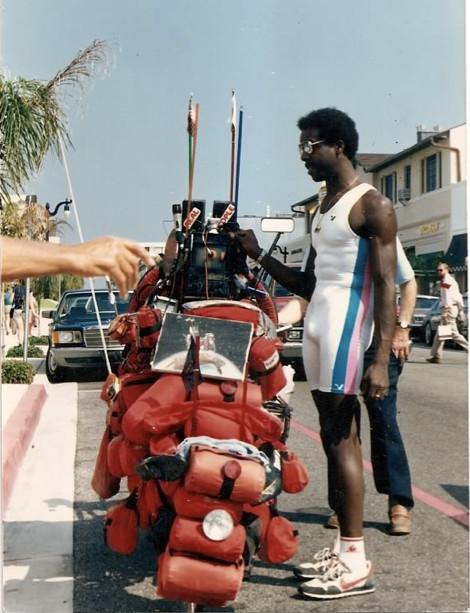
Initially, he rode an ordinary ten-speed bike of the era. with the only modifications being padded tape on the handlebar, to make sitting on it more comfortable, and mirrors on long brackets so he could see where he was going.

When he saw the way people reacted to seeing him ride that way, he decided it would be his career someday.

It wasn’t long before people started calling him “Wrong Way Wooten.” Later, he legally changed his first name to “Wrong Way.”

In his late 20s, evidently after driving a tow truck for a while, and receiving a degree in psychology, he planned his first cross-country tour. Originally, he was going to ride with five other people, but they all backed out before he started. He relates, “I learned never to count on anybody for anything.”

he built a custom bike for his purpose. It was based on a Schwinn Varsity, which was a heavy all-steel ten-speed road bike of the late 1970s, with a one-piece crank.
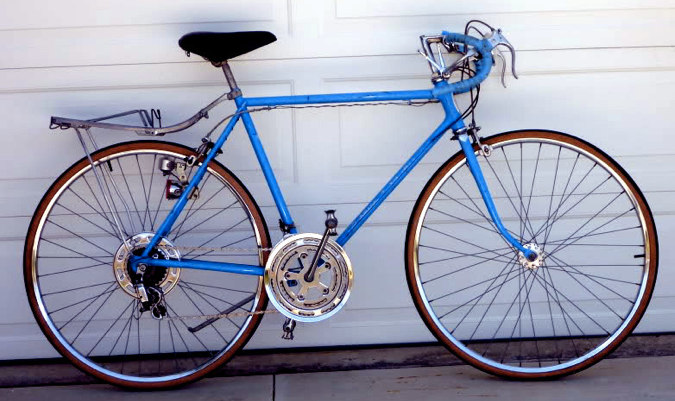


Schwinn Varsity

In addition to padding the handlebar and adding mirrors, he removed the seat, and put a portable television in its place. He then somehow attached another ten-speed bike to the rear of his bike in order to carry more gear. There is no information as to exactly how the second bike was attached. There are conflicting reports as to how much the entire contraption weighed. The report that I believe says it was 160 lbs (72 kg). Other reports put it at “over 300 pounds” and some say it was 450 lbs.



Wrong Way Wooten and his custom bike

Wrong Way converted the bike to 21 speeds, quite rare in the 1980s, but left the shifters in their original position – on the handlebar stem. This meant that he had to reach between his legs to change gears.
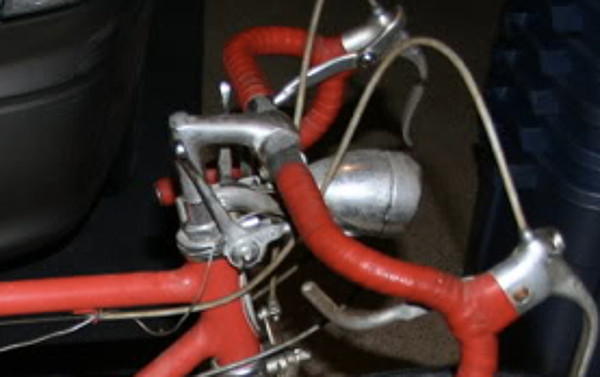


Stem shifters on a Schwinn Varsity

His bike had toe-clips, which were, of course, installed backward on the pedals.
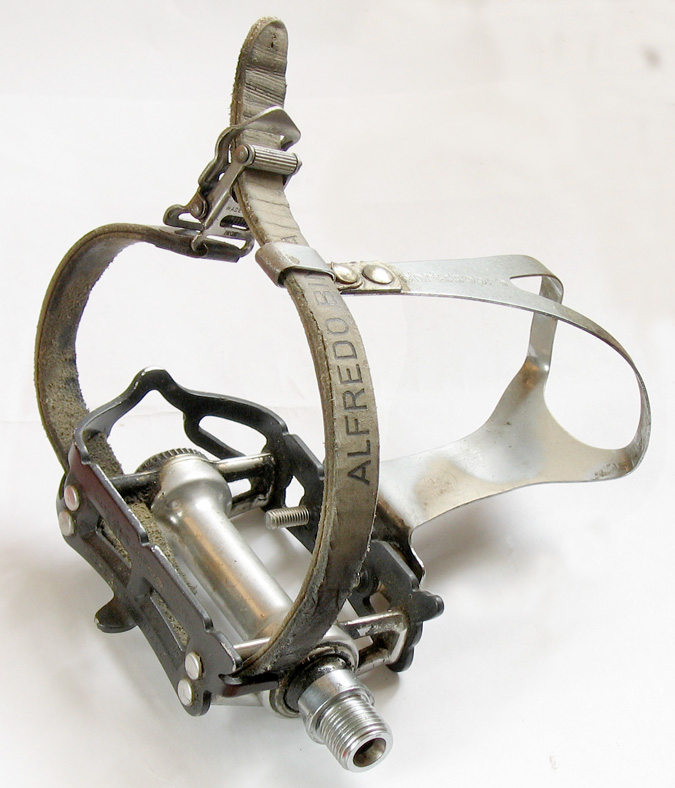


A pedal with toeclip

Before his first trip to traverse the entire United States, he studied maps. Being independently wealthy (according to what little is written – and we don’t know how he attained that wealth, but Bryn Mawr is known for its wealthy residents), he then hired a small airplane to fly low, examining his proposed route for overly steep hills, road construction and other such potential problems.

Wrong Way then set out on his journey with a specific self-appointed mission. He represented several major charities including The American Cancer Society, The American Lung Society, The Heart Fund, the Jaycees, United Way, and March of Dimes, taking donations in person and also encouraging people to donate directly to their favorite charities.

According to the legend, he criss-crossed the country several times totaling 28,000 miles (45,000 kilometers) over the next seventeen years. As he tirelessly explained to thousands of people across the country, “The main reason I do what I do is to get people to realize that they have a responsibility to other people.” When he could, he would ride more than 100 miles in a day, but on many days he couldn’t get that far. This was due to interruptions as fascinated people wanted to talk with him. He was fine with that.

To some, it looked like what he was doing, riding around the country on a bike, would be limitless fun, but he cited some problems, such as flat tires, bad weather and racists who sometimes tried to run him off the road. “I can’t hate them, then I would be just like them.”

Someone once asked what he does when he gets a flat tire. With a straight face he answered, “I set the bike on fire.”

He did not recommend that other people should tour backwards. “One mistake, and you’re history.”

As with all good legends, the stories sometimes exceed the truth. One person remembers that Wrong Way was an expert on the subject of girls. He was supposedly a remarkable cook and a karate expert. That may be true. At least one person says Wrong Way was able to read minds, responding to unvoiced questions. All say he was a brilliant conversationist, able to speak on any level from ghetto talk to erudite conversations with professors.

He has been spoken of as a loner, and in a way, I suppose he was. This was a one-man crusade, and it must have been hard for him to have permanent, deep friendships, since he was always on the move. There is an unverified story that he had a son, who he pretty much entirely neglected. It is reported that this boy had a hard time in school, being an angry, disruptive student.

With the public, he was evidently quite gregarious. On his bike he also carried a sound system, and on more than one occasion he could be seen riding backward, accompanied by blaring music – anything from opera to rock, and sometimes happily singing along.

He planned on riding for twenty-five years. Unfortunately, in 2004, at age 47, he died of a massive heart attack.

His credo was, “Bind yourself to nothing and seek harmony with all things. Only then can you be truly free.” People who remember him say he was a wonderful and very personable ambassador for kindness to others.

For more bicycle information, everything from memoirs to unexpected how-to info, check out the 500 Ways Bicycling section.
Posted on — Leave a comment

From the Worst Bumps
to the Smoothest Ride

From Belfast Cobblestones to the Modern Road: The Surprising Veterinary Origins of the Inflatable Tire

When we picture the foundation of the modern automotive industry, we usually think of industrial assembly lines, steel foundries, and visionary mechanical engineers. Yet one of the most critical breakthroughs in transport history came from an entirely different source: a Scottish veterinarian trying to make his young son’s tricycle ride a little less bumpy.

In 1887, Dr. John Boyd Dunlop was practicing veterinary medicine in Belfast, Ireland. Navigating the city’s rough, uneven cobblestone streets on horse-drawn carriages and solid-rubber-wheeled bicycles made for a harsh, jarring ride. The problem was especially severe for his nine-year-old son, Johnny, who suffered from frequent headaches while riding his tricycle.

At the time, tires were made of solid, unyielding rubber. Drawing on his medical background—where flexible sheet rubber, rubber aprons, and surgical tubing were common clinical tools—Dunlop set out to invent a dampening system that could absorb shocks from the road.

His solution was as simple as it was revolutionary. Dunlop constructed a flexible tube out of thin, sheet rubber, wrapped it around a wooden disk, and protected it with a outer casing of heavy canvas cloth. He then inflated the tube using a football pump and glued the entire assembly directly onto the wooden wheels of his son’s tricycle. The air-filled cushion—or “pneumatic” tire—proved to be an immediate success, offering an effortlessly smooth ride and remarkably lower rolling resistance.

Dunlop patented his pneumatic tire design in 1888 and soon founded the Dunlop Pneumatic Tyre Company. While initial skeptics dismissed the air-filled tires as fragile “pudding wheels,” the technology quickly proved its superiority on the bicycle racing track, where riders using Dunlop’s tires routinely dominated competitors riding on solid rubber.

As the automobile emerged at the turn of the 20th century, Dunlop’s invention was rapidly adapted for motor cars, transforming global transportation forever. Today, every passenger vehicle on the road relies on the fundamental concept pioneered in a veterinarian’s workshop to keep his son comfortable: trapping a cushion of compressed air inside a ring of flexible rubber.

Posted on — Leave a comment

Worst Bicycle Ergonomics

The worst bicycle ergonomics is surprisingly common. People often ride with their seats too low. This leads to rapid loss of energy, sore muscles and ultimately loss of interest in bicycling.

What is the correct height for your bike seat? You should get almost full extension of your legs at the bottom of the pedaling stroke. Although you normally center the ball of your foot over the axis of the pedal while riding, you can test for proper seat height by leaning against a wall, placing your heels on the pedals, and pedaling slowly backward. Your legs should be just fully extended when your heels are on the pedals.

If it has been a long while since you have ridden and you are somewhat concerned, it is quite OK to set the seat as low as it will go until you are confident again.

Posted on — Leave a comment

Worst Way to Stop a Bicycle

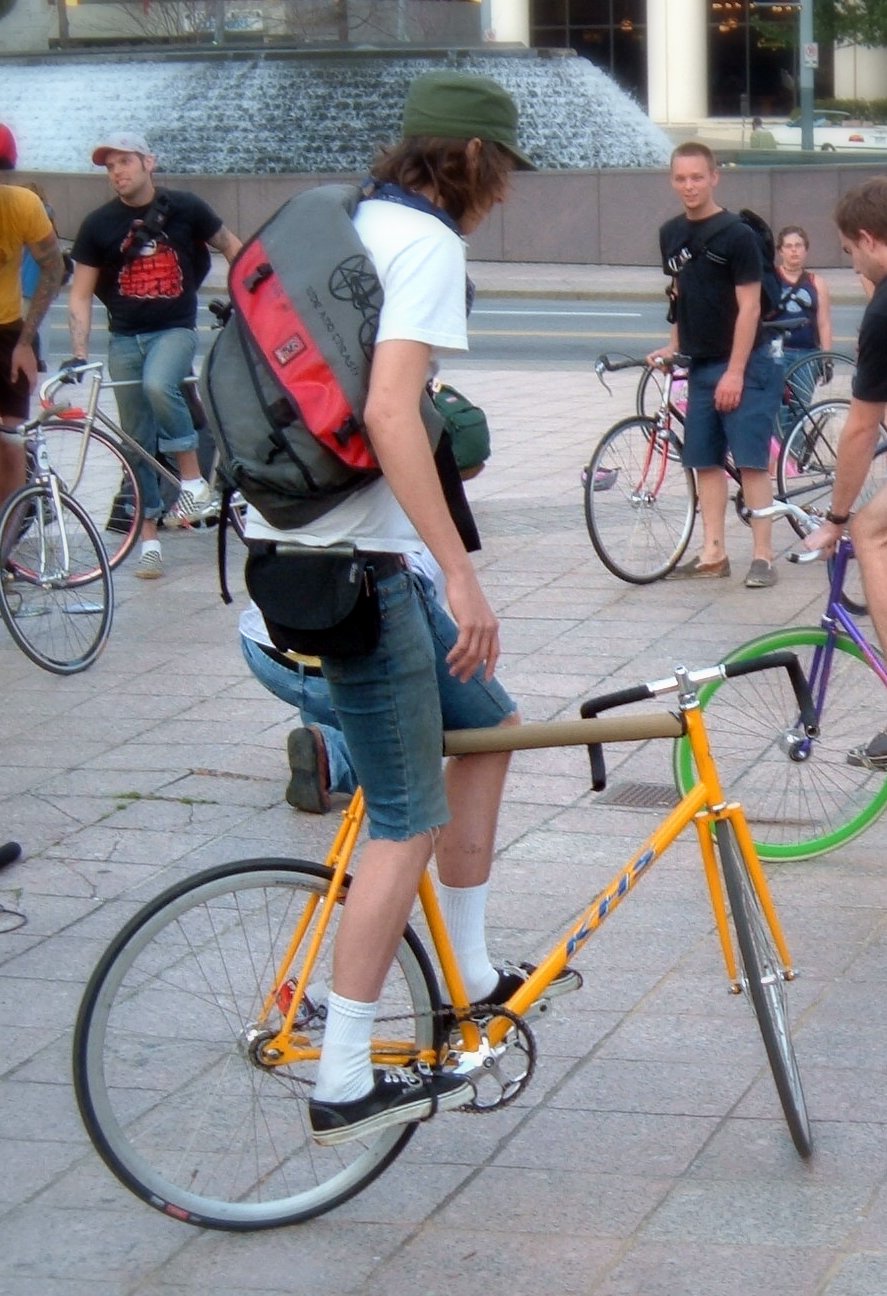
The worst way to stop your bicycle is the way almost everyone does it. They put a foot down on the ground. Instead, you might prefer the ‘invisible kickstand’ trick.

Next time you are waiting at a red light while on your bike, you may want to begin practicing a technique called the ‘track stand.’ As you come to a stop, but before putting a foot on the ground, turn your front wheel about 70 or 80 degrees to the right or left. If your bike is not facing uphill, turn the front wheel facing uphill. This means that your wheel will probably be turned to the left, since most often in non-British countries, the road curves uphill toward the centerline, so that rainwater will run off. Keep steady pressure on one of the pedals, but balance the tendency to roll backward, downhill. With practice, you will find that you can come to a stop and never have to put a foot on the ground. You will be able to rock slightly back and forth, balancing between rolling back and pushing forward.

This trick is used extensively by road racers who don’t want to deal with repositioning a foot on a pedal when it is time to resume riding. For the mountain biker, it helps develop fine control of the bike at slow speeds such as when you are biking along a narrow cliff.

The fellow in the picture above is using a fixed-gear bike (a ‘fixie’) but it can be done on almost any kind of two-wheeled machine. With a fixie, it is not necessary to aim the front wheel uphill.

If you don’t have any slope at all, you can place a hand or foot on the front tire to push the bike backward as needed.

As the guy in the picture illustrates, with practice track stands can be done hands-free.

Posted on — Leave a comment

Worst Bicycling Experience

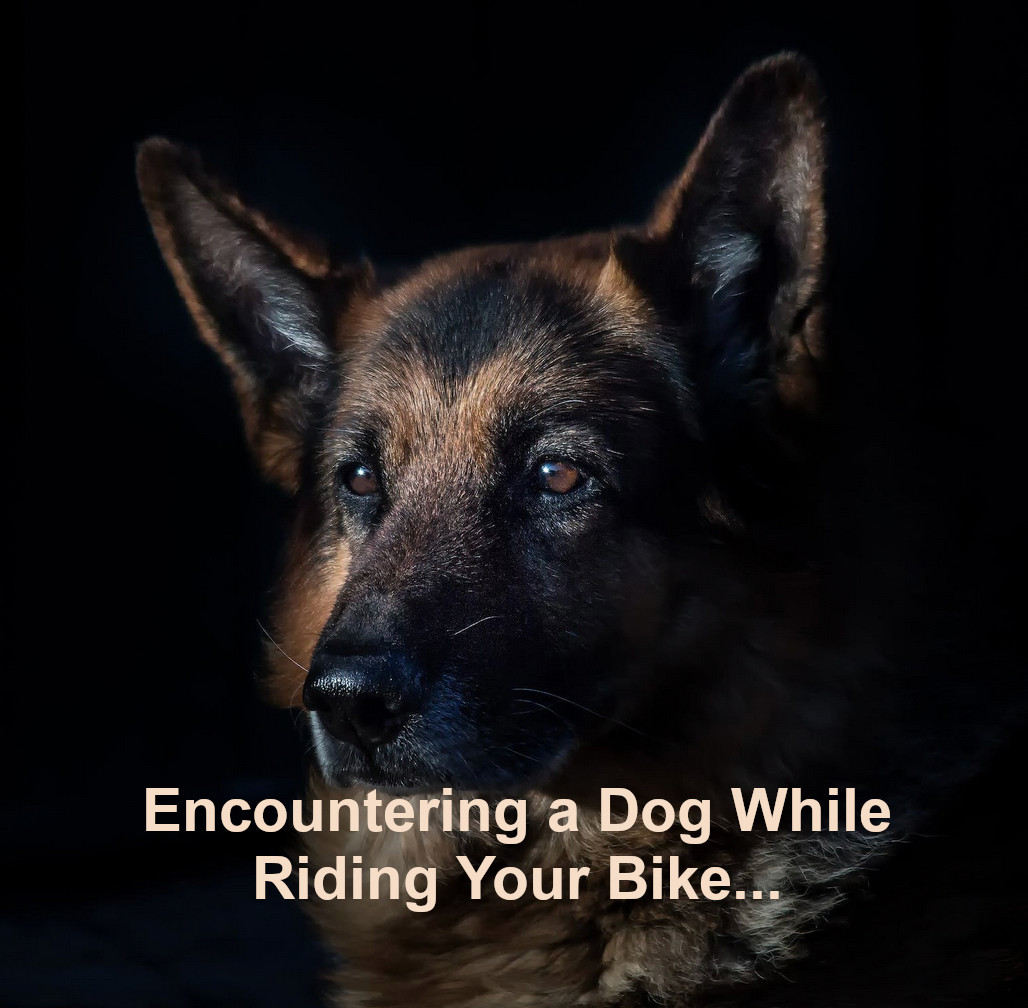
Some will tell you the worst thing that can happen while riding your bike is being chased by a dog. If that happens, here’s what to do:

1. Slow down or stop. There’s no fun for the dog in chasing something that isn’t moving.

2. In a deep voice, firmly order the dog to “go home.” They often will, but in any case, you’re making it clear who’s in charge and that you do not approve of their current behavior.

3. Get off the bike and place it between you and the dog. It’s a fence to protect you, and if necessary, you can press it against the dog in self-defense.

4. Yell for help. The owner will most likely take control as soon as your plight is discovered.

5. If you encounter the same dog frequently, contact your local animal control agency. In most neighborhoods, it’s illegal to let dogs run loose and bother people.

Posted on — 1 Comment

Five Years In The Bike Shop

Copyright 2013 – 2026, John Flaherty

There was once a little bicycle shop, ordinary in every way, except for the people associated with it. Brian the owner, the employees, and many of the customers were the most interesting and eccentric people I have ever met. That’s what this book is about. I have changed the location and the names to protect those involved. Everything else is true, exactly as it happened. The bike shop lasted five years before it came to a strange end. Welcome to the story of the shop and it’s people. Continue reading Five Years In The Bike Shop