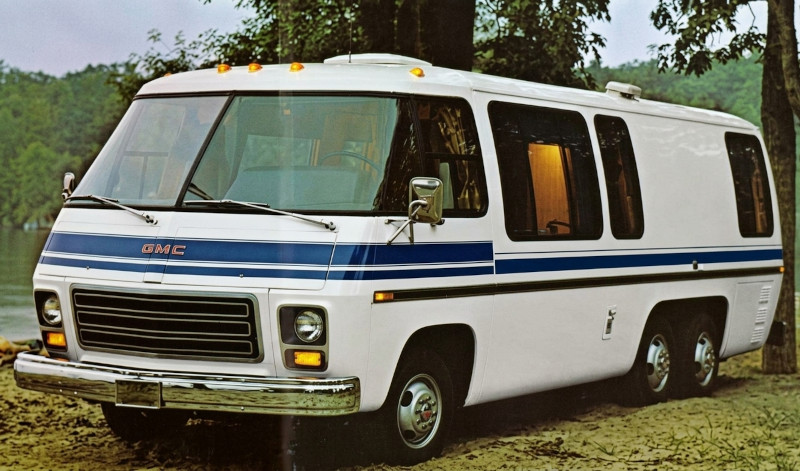
The GMC Motorhome (produced from 1973 to 1978) is widely considered a design masterpiece of its era, featuring front-wheel drive, a low profile, and a sleek fiberglass-and-aluminum body. It’s sleek look causes many people upon seeing one for the first time to believe that it is a current, ultra-modern motorhome.
I bought one of these in 1978 that was four years old. I like to claim that I spent more time under it fixing things, than in it. I drove it back and forth across the USA for three and a half round trips, and into Canada twice during the six years that I owned it. It looked almost identical to the one pictured above.
However, its unique engineering choices and vintage mechanicals came with a specific set of notorious problems and vulnerabilities:
Mechanical & Drivetrain Issues
Front-Wheel-Drive Heavy Loads:
The GMC used GM’s Unified Powerpack – the same 455 cu in (7.5L) or 403 cu in (6.6L) Oldsmobile V8 engine and Turbo-Hydramatic 425 transmission used in the Oldsmobile Toronado and Cadillac Eldorado. While innovative for an RV, transferring that much torque to front drive axles carrying up to 12,000+ lbs caused premature wear on CV joints, front axle shafts, and front wheel bearings (which often required replacement or repacking every 25,000–30,000 miles). Yes, I had to replace a CV joint.
Engine Bay Overheating & Vapor Lock:
Because the front-wheel-drive engine was shoved tightly under the cab forward of the front axle, ventilation was tight. Under heavy loads, mountain climbs, or hot summer driving, the engine bays were prone to extreme heat build-up, occasionally leading to vapor lock in the mechanical fuel pump system. I didn’t have that problem, but found the transmission oil turning brown, so I had to install an auxiliary cooler.
Front Traction Problems:
Because all driving force came from the front wheels while much of the living space and cargo weight rested over the rear tandem axles, traction could be poor on wet grass, steep unpaved inclines, or loose gravel. Towing heavy trailers could unweight the front end further. I never experienced that.
Rear Suspension & Brake Shortcomings
Air Suspension System Leaks:
The GMC Motorhome famously omitted a rear axle across the middle of the vehicle (dual rear wheels, or ‘dualies’), using an electro-pneumatic air bag system to self-level the rear tandem wheels and provide a smooth ride. The original rubber air bladders, air compressor, leveling valves, and air lines are notoriously leak-prone over time, causing the rear end to sag or drop completely to the bump stops when parked or driving. I never had a leak, but an air bag blew out in the middle of one night. I thought someone had shot the side of the motorhome with a shotgun. In the morning, I discovered pieces of rubber blown twenty feet (7 meters) away. People claimed a smooth ride, but no, it was noisy and bumpy, although perhaps no more than most motorhomes.
The differential gearing was the same as the Oldsmobile, but the wheels were larger and the vehicle weighted much more. It was geared so high that it couldn’t climb out of some not-so-steep driveways.
Not only that but the tandem rear wheels put tremendous lateral stress on the bearings when turning sharply such as backing into parking spaces. As a consequence, I had a wheel fly off on the freeway in Ohio one morning. Fortunately, the bearing and brake parts were standard Oldsmobile Toronado, so I was able to get replacements at a nearby junkyard. I also had to replace a pivot pin at another time.
The frame was a little lighter duty than ideal. GM sold shim kits so as the frame slowly twisted at the rear wheels, the wheels could be made perpendicular again.
Marginal Braking Performance:
Stopping a 10,000-to-12,000 lb vehicle with 1970s drum brakes on the four rear wheels and discs up front was challenging. Brake fade on long downhill mountain descents was a common complaint among owners, requiring careful gear-down engine braking. I never experienced that.
Electrical Flaws
12V Wiring & Grounding Issues:
The original 12V DC wiring harnesses suffer from inadequate grounding, leading to flickering lights, erratic instrument panel gauges, and persistent battery drain issues when sitting. I didn’t have that, but I could understand the problem. Lights and other components had to have two wires instead of one. In a steel vehicle, the electricity can be grounded through the frame.
Ownership & Living Space Drawbacks
Even in the late 1970s, replacement parts were expensive and hard to get. At the same time, owners of the ubiquitous Class C motorhomes, those with an ordinary van chassis, were low-cost and easy to maintain.
The curved entry door would slowly uncurve. General Motors offered a special block and tackle kit to bend it back into shape. Mine leaked when it rained.
The curved walls made it feel small inside. Curtains had to have runner attachments at the top and bottom.
Fuel Economy:
Despite its aerodynamic styling compared to boxy competitors of the 1970s, the massive big-block Oldsmobile V8 typically delivers only 8 to 11 MPG on highway trips. Yup, I averaged 10 miles per gallon.
A total of 12,921 GMC Motorhomes were produced during its manufacturing run from model years 1973 through 1978.
Two length options were offered:
26-foot models: Accounted for the vast majority of production (around 11,000 units).
23-foot models: Made up the remaining ~1,900 units.
Mine was 26 feet long.
Survival Rate:
One of the most remarkable aspects of the GMC Motorhome is its longevity. Thanks to its aluminum and fiberglass body construction and an enthusiastic enthusiast community, an estimated 8,000 to 9,000 of these motorhomes are still in running condition and on the road today.
On The Other Hand:
Owners of recent motorhomes made after approximately 2014 have a lot of complaints about low-quality materials, over-engineering with too many failure-prone electronics, and poor workmanship. Rain leaking in and causing mold damage is common. One of the biggest issues seems to be with the slide-out rooms. Imagine getting ready to leave your campground, but you can’t get a slide to go back in!