The man who started the California gold rush, James Marshall, after a first small strike, was able to find no other gold for himself, and died a penniless alcoholic.
California State Parks says Marshall continued working as a blacksmith and in small gold mines, and that he died at age 75 in 1885. The state had actually awarded him a pension in recognition of his role, but it ended in 1878 amid criticism of his drinking.
Here are some particularly fascinating details about Marshall and the discovery:
1. He wasn’t actually looking for gold
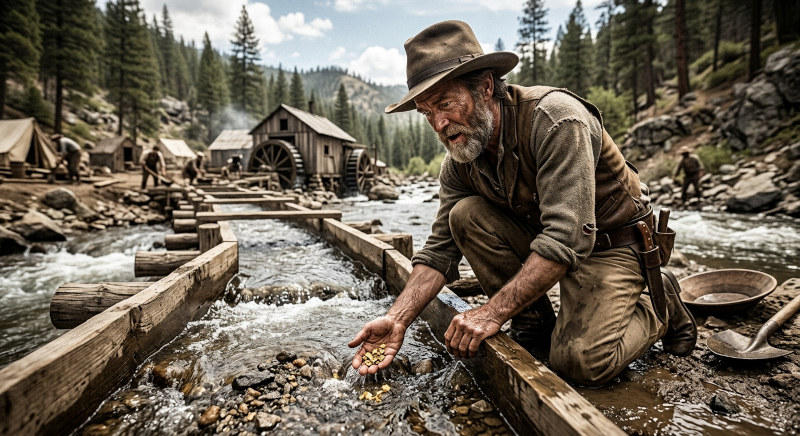
Marshall was a carpenter and mill builder working for John Sutter. He was building Sutter’s sawmill on the South Fork of the American River when he noticed something shiny in the mill’s tailrace on January 24, 1848.
In other words, one of the biggest gold rushes in history began because a carpenter was checking whether his drainage ditch was working properly.
2. His first reaction wasn’t “We’re rich!”
Marshall immediately suspected the metal was gold, but he was concerned about something much more mundane: finishing the sawmill. He and the workers temporarily stopped work and collected some of the gold, but the implications of the discovery weren’t immediately obvious.
3. The first mining tool was… a knife
This is one of my favorite details.
The flakes were difficult to pick up with the fingers, so the workers discovered they could use a knife to scrape up the gold. According to the California Geological Survey, the knife was therefore among the earliest mining implements used at Coloma. Several ounces were collected this way.
4. Marshall and Sutter tried to keep the discovery secret.
They realized that a gold discovery could cause enormous trouble for Sutter’s plans. They attempted to keep it quiet.
It didn’t work.
News leaked through the workers and then spread to other settlements. One of Sutter’s associates reportedly couldn’t resist showing the gold to people in other places.
And within a year, thousands of people were pouring into California.
5. Marshall got almost none of the fortune he created.
This is the cruelest part of the story.
Marshall eventually owned or participated in mining ventures, but he never found the fortune that prospectors dreamed about. A mine near Kelsey failed and left him nearly bankrupt. He also tried running a vineyard, but that venture failed as well.
So the man who effectively announced, “There’s gold in California!” couldn’t turn that information into a fortune for himself.
6. He actually received a government pension.
The “died penniless” version leaves out an interesting twist.
In 1872, the California legislature awarded Marshall a $200-per-month pension for two years because of his role in the discovery. It was subsequently reduced and extended, but finally ended in 1878.
At a time when $200 a month was substantial money, this could have provided considerable security. Marshall apparently wasn’t very good at turning security into prosperity.
7. Alcohol really was a problem.
There is historical evidence supporting the alcoholic part of the story. California State Parks specifically says his pension was cut amid criticism of his “weakness for liquor.” A later congressional account describes him as eccentric, contentious, unkempt and almost poverty-stricken.
But “penniless alcoholic” makes it sound as though he spent his entire later life as a hopeless drunk. That’s an oversimplification. He continued working as a blacksmith, carpenter and miner, among other things.
8. He was eventually driven out of Coloma.
Marshall became involved in a conflict involving the Nisenan people (a Native American tribe) and gold miners from Oregon. According to the historical account preserved by the Coloma community, Marshall tried to defend his Nisenan friends after violence erupted, and eventually had to flee for his life.
That’s a remarkably dark footnote to the story: the man whose discovery brought thousands of miners into the region eventually had to flee the region because of the violence accompanying the Gold Rush.
9. California’s population exploded almost immediately.
When Marshall found the gold, California’s non-Native population was only about 14,000.
By the end of 1849, it was approaching 100,000.
By 1852, it had reached roughly 250,000.
So Marshall’s discovery didn’t merely create a mining boom. It helped transform California from a remote frontier region into a rapidly growing American state.
10. The discovery wasn’t actually the first gold found in California.
This is an important historical wrinkle.
Marshall was not the first person ever to discover gold in California. Gold had been found in California before 1848, including discoveries in the Los Angeles area. What made Marshall’s discovery historically extraordinary was that it was the discovery that set off the great international rush to California.
11. Even the exact date was once disputed.
Today you’ll see January 24, 1848 everywhere, and that’s the date officially commemorated.
But Marshall himself gave somewhat inconsistent accounts of the precise date in later years. In some accounts he said January 19; in another he said the 18th, 19th or 20th. The date January 24 became firmly established later.
So even the famous “January 24” has a little historical fog around it.
12. Marshall’s prediction about his own fame came true.
Marshall reportedly said:
“Someday they’ll make a fuss over me.”
They did.
California erected a monument over his grave in 1890, and it became the state’s first historic monument. His grave overlooks the very valley where he made the discovery.
There’s a wonderfully ironic ending here: Marshall spent much of his later life frustrated that he hadn’t been adequately rewarded for the discovery, but eventually the State of California literally built a monument over his grave.
And perhaps the strangest part of the whole story is this:
Marshall discovered something that ultimately produced an estimated fortune for thousands of other people, transformed California, accelerated American settlement of the West, and helped change the demographic and economic history of the United States. Yet the discoverer himself never became rich from it.