Starfish have a gross and unusual manner of eating. They eat by regurgitating their stomachs outside of their bodies. To consume prey like clams or mussels, a starfish pries open the shell slightly, ejects its lower stomach out through its mouth, and digests the prey’s tissue right inside the victim’s shell before pulling its stomach back in.
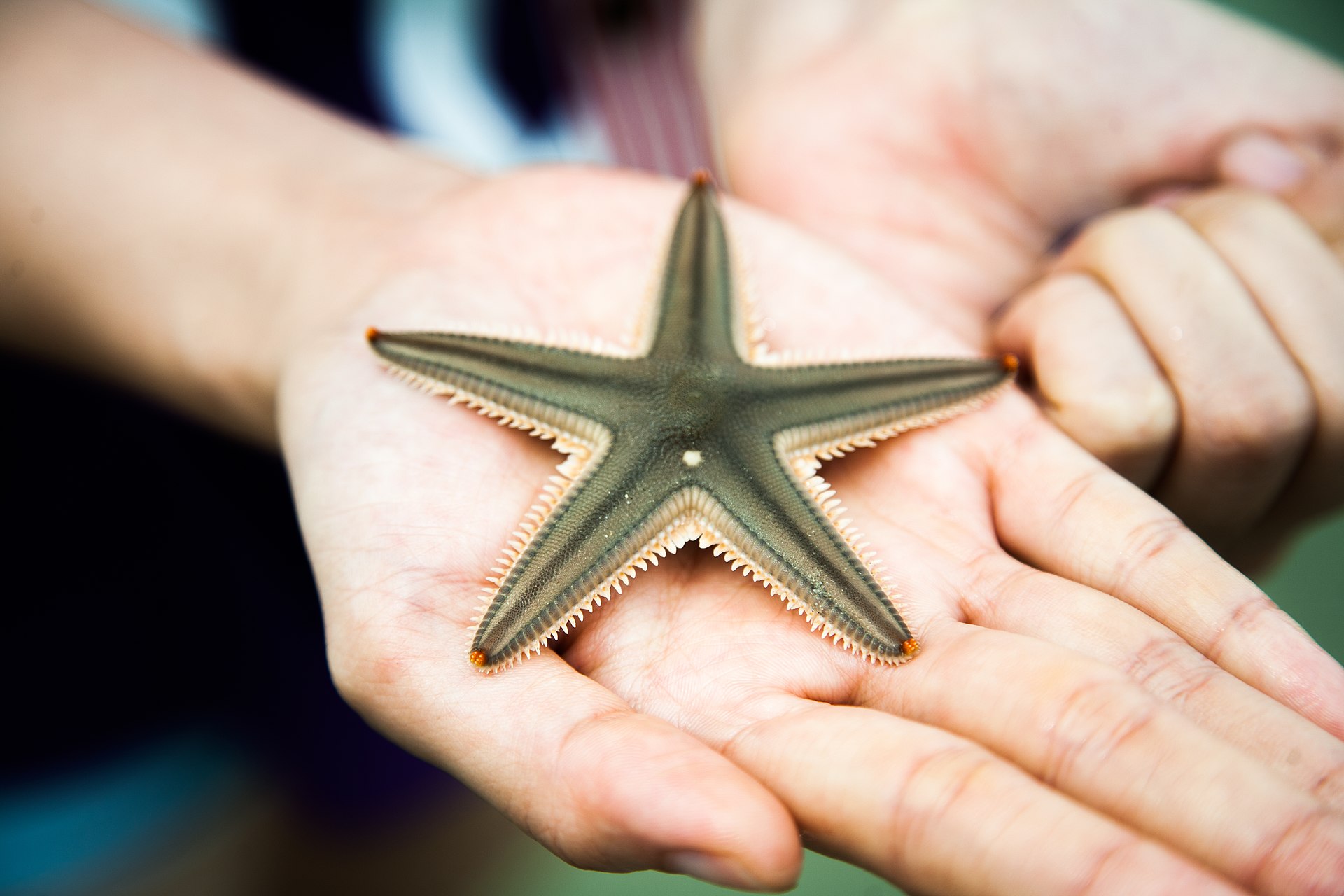
Starfish aren’t actually fish. They are echinoderms, closely related to sea urchins and sand dollars. Because they lack gills, scales, and backbones, scientists and marine biologists prefer to call them “sea stars.”
They can regenerate entire lost arms. If a predator bites off a sea star’s arm, the animal can grow a brand-new one. In some species, a single severed arm can even regenerate an entire new body if a central part of the core remains attached.
They pump seawater through their bodies instead of blood. Sea stars do not have blood or a central heart. Instead, they use a vascular system that pumps filtered seawater through their bodies to deliver nutrients and operate their feet.
They have eyes on the ends of their arms. At the tip of each arm sits a small micro-eye spot that detects light and dark. While they cannot see detailed images, these eyes help them navigate toward light sources and avoid shadow-heavy predators.
They move using thousands of tiny tube feet. On the underside of their arms are hundreds of tube feet operated by hydraulic pressure. These feet allow them to walk smoothly across the ocean floor, adhere tightly to steep rocks, and open tough mollusk shells.
Not all sea stars have five arms. While the classic sea star shape features five arms, some species have far more. The sun star can have up to 40 arms, while the crown-of-thorns starfish typically has between 13 and 21.
They can change their sex. Certain species of sea stars are born male and transition into females later in life as they mature. Others can reproduce both sexually by releasing gametes into the water and asexually through body division.
Their skin is covered in tiny protective pincers. Called pedicellariae, these tiny claw-like structures sit on the surface of the sea star’s skin to prevent algae, parasites, and debris from settling on them and blocking their breathing gills.
They have no centralized brain. Sea stars manage complex movements and hunting behaviors entirely through a decentralized nervous system. A nerve ring around the mouth connects to radial nerves running down each arm, allowing the limbs to act independently yet cooperatively.