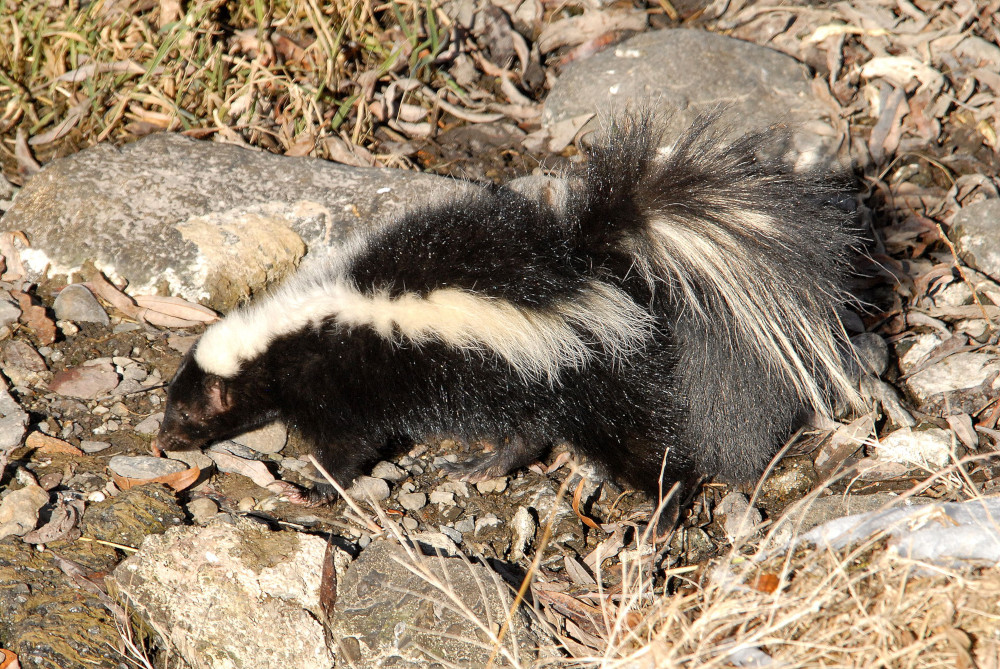
If there is time, a skunk will warn you before spraying. The warning has two phases. First the skunk pats his front feet on the ground several times. Then he shakes his head from side to side. He may even raise his tail and hiss. If you aren’t gone by then, too bad!
Skunk Facts
Their Spray Can Reach Up to 10 Feet Away
Skunks release their foul-smelling liquid from two glands under their tail with impressive precision. They can accurately target an intruder’s face from 10 feet away, and the scent can be detected by humans up to a mile downwind.
They Use Their Spray as a Last Resort
Skunks only carry about 5 to 6 tablespoons of spray (thiols) at a time, and it takes up to a week to replenish a depleted supply. Because leaving themselves defenseless is risky, they will give fair warnings first.
They Are Immune to Snake Venom
Skunks are natural predators of snakes, including poisonous species like rattlesnakes and copperheads. They possess a natural immunity to snake venom, allowing them to hunt and eat venomous snakes without harm.
Great Horned Owls Are Their Primary Predator
Most mammals quickly learn to give skunks a wide berth, but Great Horned Owls are an exception. Like most birds, owls have an exceptionally weak sense of smell, making skunks one of their favorite primary food sources.
Tomato Juice Doesn’t Neutralize the Odor
The popular urban legend that tomato juice removes skunk scent is false; it merely masks the smell temporarily by overwhelming your nose (olfactory fatigue). To chemically neutralize the sulfur-based thiols, a mixture of hydrogen peroxide, baking soda, and dish soap is required to oxidize the chemical compound.
They Have Terrible Eyesight
A skunk’s vision is extremely poor—they can barely see objects more than 10 feet ahead of them. This poor eyesight, combined with their instinct to stand their ground rather than flee, is the primary reason so many skunks are struck by cars on highways.
They Are Natural Pest Controllers
Skunks are opportunistic omnivores whose diet consists heavily of insects. They spend their nights digging up grubs, beetles, wasps, scorpions, and garden pests, making them highly beneficial for local ecosystems and agriculture.
Spotted Skunks Do Handstands to Threaten Predators
While striped skunks simply arch their backs and stomp, the smaller Western and Eastern spotted skunks perform an elaborate acrobatic handstand on their front paws to look larger and aim their scent glands directly at a predator before spraying.
They Belong to Their Own Unique Family
For a long time, skunks were classified in the weasel family (Mustelidae). However, genetic research in the late 1990s revealed they are distinct enough to warrant their own separate family, Mephitidae, which translates from Latin to “foul stench.”
They Don’t Formally Hibernate
During severe winter cold, skunks enter a state of torpor—lowering their body temperature and sleeping for long stretches—rather than true hibernation. To stay warm, females often huddle together in shared underground dens, while males typically remain solitary.