Posted on — Leave a comment

Worst Pickleball Fiction

By Jeff Napier

Our pastor, although a very nice and well-educated guy, isn’t very good at counseling, and he knows it, so I have taken over most of the lay counseling that happens at our church. One day I had an appointment with Jeremy, a 21-year-old fellow who according to rumors, had recently inherited 78 million dollars.

On a Tuesday at 3pm on the dot, he walked Pickleball Fiction - The $78 Million Maninto the little church office, and I met him for the first time. He was huge. I mean, he was around 6″ 3′ tall, and big-boned. Well, fat, actually. His pale skin, short blond hair, wispy beard, and goofy sweater made him look even larger. He greeted me with a somewhat unsteady, high-pitched voice.

We started off with small talk. I always like to make my clients feel comfortable as soon as I can. He started slowly and hesitantly, but fairly quickly steered the conversation to his problems, evidently comfortable enough with me already to let go of some of his inner secrets.

First, he said he needed a girlfriend. Then he said, that wasn’t really it. He figured a woman would come along in due course. I agreed, that at 21, he needn’t be in a hurry. I then sat back and just listened. I have learned if you remain silent, people will almost always fill the silence. And, they’ll usually fill it with what they really need to say.

It turns out his real problem is that he just didn’t know where he fit into society. He felt no sense of identity. It didn’t help that his mother had died of cancer three years ago, and his father died of a sudden heart attack just a few months ago. Of course he was still grieving, but it was more than that. He didn’t fit, and that made him lonely. His eyes filled with tears. He explained it wasn’t so much the loss of his parents. He was grieving the loss of himself. He was so sad that he just didn’t know how to “be regular, be a part of society” as he termed it. This great big young man then put his hands over his eyes and broke down into complete sobs of sadness. I waited patiently, as I have learned to do. In time, he recovered, apologized for crying. I told him many of my clients cry, and it is just fine, and actually a good, healing thing. I brought the conversation out to a less heavy level.

I asked about college, but no, he didn’t want to do that. I made a mental note to see if I could direct him toward getting an education at some later point, if he would agree to start seeing me weekly. I wanted to know why he didn’t want college, and he said he had plenty of money, so wouldn’t need a career, and therefore wouldn’t be needing college. I thought about how much fun he was missing out on, but this first session was way too soon for me to start guiding him in any direction.

I have been told that as a counselor, one should follow one’s instincts, one’s curiosity, so I asked about the rumors of his inheritance. The pastor had told me that Jeremy’s family had long supported the church in a big way.

Oh, yes, it was true. He had a team of nine people managing his money. In fact, he wasn’t allowed to manage his inheritance at all until age 25, at which time, he would get full control. In the meantime, he was allowed a trust fund of $6,000 per month, after taxes.

Hmmm, At his age, I could really live it up on that, I was thinking to myself.

Being our first meeting, I just asked a few questions, and let him drive the conversation. It seems he was not only lonely, but felt he was getting fatter by the moment, because all he did was watch TV and drink root beer. He loved his root beer. And, he was having troubles with money.

What???

It’s true. He couldn’t quite make ends meet on the $6,000 per month. By the 20th of the month, he was always borrowing $10 or $20 from his friends for food, was late paying the rent on his apartment, and felt quite embarrassed about that. Oh sure, he paid his friends back right after he got his check, but he felt like he was pretty out of control about the money. I asked him where it all went, and his first response was “I don’t really know. I don’t understand it.” Upon pressing, it seemed quite a bit went into customizing his motorcycles – he had three of them, taking friends to dinners, going to concerts, and buying fancy clothes. Here in the office, he was wearing tattered shorts, worn out Keens, and a T-shirt. Go figure!

He had another problem: Headaches. Everything gave him horrible migraines. Stress. Chocolate. Peanuts. Alcohol – even a single glass of wine. He had been to many doctors, and they prescribed this and that, and every medicine he tried either didn’t work, or gave him other untenable symptoms.

Jeremy was messed up, and I was sure that the Lord could work through me to help him. I convinced him to schedule weekly visits with me. We prayed together for a short while, and then I sent him on his way. He promised to meet me next week.

Jeremy was true to his word, and appeared at the church office right at 3pm the following week, and the week after that, and so on. After about six sessions, I hadn’t really helped him much, but he did seem to enjoy having someone to talk with, even though I was an old gray gent, more than three times his age.

I became convinced he needed an activity, something involving a social group. Church would have been sufficient for some people, but for Jeremy, our various social activities only made him feel more like a misfit. I definitely pushed as hard as I dared to get him to enroll in college, but Jeremy wasn’t having it.

He bought himself a guitar after I hinted around about music, took a few lessons, and gave it up. He spent $5,000 on a fancy electric piano, took a few lessons, and then gave that up, too. I suggested basketball. He laughed at me. I suggested tennis, and he actually tried it, but said it gave him a headache and hurt his knees. I could imagine it did. He was a big guy, but his knees were probably just ordinary size.

Then one day while out for a walk, I saw a bunch of people playing a funny little game that looked like tennis. I stepped closer to the fence, and saw that while it looked like tennis, there were some differences. The courts and nets seemed a bit smaller. And they were using little plastic balls full of holes. They reminded me of whiffle balls that we used with plastic bats to play baseball when we were small children. Most of the people seemed to be elderly, like me, but there were some twenty-somethings and people in their thirties and forties as well. They had a weird way of calling score: They kept saying three numbers, like “7-4-2.” I was going to have to ask about that someday. One of the players who was evidently waiting between games started to approach the fence. I was feeling shy, so I walked away before he could trap me in a conversation.

The following week, figuring it would be easier on the knees, I suggested this new game to Jeremy, and told him where I had seen the people playing. No, he wasn’t going to do that, he told me. As usual, we talked an hour, and I didn’t significantly change his life. I knew our sessions were drawing to a close, because I just couldn’t go on not helping him.

In the next weekly session we started talking about this and that, with me trying to focus him on telling me how his week had been, in case I could find something to leverage that might give me an insight as to how to help him. I had prayed all week for some sort of thing I could do to help Jeremy. So far as I could tell, God didn’t have any direct answer for me. Or at least I couldn’t hear the answer.

My mind started to wander, thinking about God and ‘answers’ and so I wasn’t listening carefully, but I thought I heard Jeremy say something about “pickleball.” I asked him to repeat it. He said simply that the game was called pickleball and he had tried it out. I asked, “And, how was it?”

He said that while he did try it, he didn’t like it, but was at least proud that he had once again tried something new. That had been what I was pushing all along – that he had to keep trying things until the right one came along. I talked metaphorically, because in counseling that can sometimes work where direct advice doesn’t. So I said it was like Julia Child, the famous French chef. Before she took up cooking, she tried hat making. That fully didn’t do it for her, but she kept trying things until she discovered cooking.

I asked why he didn’t like pickleball, and he told me that he felt intimidated. Everything he did, he did wrong. Every time he tried to hit that darn little ball, it went into the net or sailed out of bounds. Every place he stood on the court, the other players told him it was the wrong place. After forty-five minutes, his legs hurt. Not from running around to hit the ball, but from being told he was supposed to stand at the kitchen line, or at the baseline, and then having to quickly move to the other line.

Kitchen line? Yes, evidently, pickleball players have a zone seven feet in front of the net in which they can not hit the ball unless it has bounced. They call this the “kitchen.” On top of everything else, he kept smacking the ball before it bounced, and it embarrassed him. So, he wasn’t going back.

Well, another wasted hour, or so I thought.

The following week, I was planning to tell him our sessions were done, and to suggest a psychologist, hypnotherapist, or an NLP practitioner. I was planning, but never got the chance. He came in wearing a smile. I had never seen Jeremy smile. Ever. It just wasn’t part of his set. But today he smiled. I had to ask. It turns out, on some sort of whim, what he called, “perhaps a self-punishing whim” he went back and played pickleball again. He was a little better than the last time, and some of the people he had played with before had not only remembered him, but welcomed him back with big, open arms. He noted that the fact that they acknowledged him like that made him feel really, really good.

And something else had happened. He didn’t have a headache afterward. Or more specifically, he might have had a headache, but didn’t really notice.

We spent the hour talking about pickleball. Or rather, he talked about pickleball, and I mostly listened. I didn’t have to ask questions to draw him out, and I was smart enough to let him run with it. He was actually, truly excited about something for the first time in his life. I asked about that scoring thing, that business with three numbers. He tried to explain something about “first server” and “second server” but I didn’t get it. That wasn’t important. The important thing was that he was having fun telling me about something that excited him.

Let’s cut out the long middle of the story and go to the end. Jeremy continued to have sessions with me. He became not only a regular pickleball player, but totally enamored of the game. He started to lose weight. I didn’t notice at first, but one day he mentioned he had lost almost twenty pounds. He said he went to a tournament, placed third in mixed doubles along with a young woman, and was rated 3.5, whatever that meant.

In time, I found out what 3.5 meant. Jeremy had been pestering me to come play pickleball, but I had been resistant for a while. I am often too shy for my own good, and I, as a lay counselor, of all people, should know better.

Finally, he wore me down, and on a Saturday afternoon, I tried the game. Just like Jeremy, I was embarrassed by my own foolishness. It reminded me of my first time square dancing. My wife took me, and all evening I was always in the wrong place, facing the wrong direction, and doing the wrong things.

At least I was facing in the right direction in pickleball. But one time, I even got that wrong. Someone hit the ball high and far back, and I ran backward to get it. Somehow, I fell over my own feet, and bumped my head. Oh, that hurt. Fortunately, it wasn’t serious. I was able to get up and keep playing. The other players explained to me that a person needs to turn around facing away from the net, to run behind a high ball, stop, turn around facing the net again and then hit the ball, in order to be safe and effective. Evidently, it is faster to turn and run forward, than to try backpedalling. Yes, I was fully embarrassed to fall in front of those people. It could have been worse. I was almost injured. I swore in a very un-religious way to myself that I would never, ever play pickleball again.

I was back on Sunday. And Monday. And Tuesday, and for the life of me, I can’t tell you why. But I was really, truly enjoying it. I tried to explain it to my wife, but she just shook her head and said, “Winner, winner, chicken dinner,” evidently acknowledging my new interest and giving me her support.

It’s nice being retired. Besides my work at the church, I have an open schedule, and I’ve been filling it with pickleball. I now know why they have a three-part scoring system, and even know what it is, from personal experience, to be a 3.5.

Oh, Jeremy. You might be wondering how it turned out for him. The years passed, and he stayed with pickleball, playing nearly all day, every day. He became very physically fit. His headaches mostly subsided. He explained to me that he still has headaches from time to time, but for the most part, they are so minor, so much in the background, he just tunes them out, and can enjoy whatever he is doing. He says part of the problem may have been the root beer. He has given up most sugary and starchy foods.

I asked him about that. He said he noticed some of the pickleballers who were in their sixties and seventies were as spry as kittens. That they could move like 16-year-olds on the court. Upon talking with them about that, he found a common thread among them. Their diets were light on sugary and starchy foods. Sugar, as he put it, is an enemy to good health and energy. He had even given up his beloved root beer. He said it was easy when he figured it was partially to blame for his headaches.

On his 25th birthday, he came into full control of his inheritance. I was worried that he’d blow the whole works on a yacht, buy a sports team or a TV station, or find some way to spend all the money quickly. But no, he bought an average three-bedroom house for himself and his wife. Yes, I did say his wife. He met a pretty little thing on the pickleball courts. She’s the one who placed third with him in his first tournament. She adores him as much as he adores her. She is as tiny as he is tall. They are a great couple. They have come for a couple of co-sessions with me. Not because they need anything, but just want to “stay tuned-up as a couple,” as they call it. I can tell they are lifers. They’ll stay together for the long run. I saw her last week, and noticed she is pregnant. I asked, and sure enough, they are expecting twins. “Two more pickleballers,” she explained.

Late breaking news: The four city pickleball courts were becoming overcrowded. As you may have heard, pickleball is the fastest growing sport in America. Jeremy and his wife have made arrangements with the City Parks and Recreation Department to donate $300,000 for six brand new courts. I can’t wait until they’re built!

It seems God has given Jeremy, and the rest of us, an answer in the form of a little plastic ball full of holes.
Posted on — Leave a comment

Worst Way to Ride a Bicycle

Wrong Way Wooten,
World’s Most Eccentric Bicycle Tourist

Copyright 2014-2026, Jeff Napier

You may occasionally hear someone refer to doing something oddly, or backward, as “Wrong Way Wooten.”
This has become an expression almost entirely detached from its roots. Something like, “Who is John Galt?” That came from the classic novel, Atlas Shrugged, by Ayn Rand. But what about “Wrong Way Wooten?” What’s that all about?

In approximately 1955, Tom Wooten was born in Bryn Mawr, Pennsylavnia.

This place with the weird spelling (pronounced “brin mar”) is approximately eleven miles outside of Philadelphia. Bryn Mawr means “Big Hill” in Welsh. This is a little town of approximately 4,000 people with a neat little downtown where most of the buildings, and most homes, are made of red or orange brick. Bryn Mawr is known as one of the wealthiest areas in the United States, and that figures into our story later on. Ten percent of the population is black, ten percent Asian, and the rest mixed or white.


Bryn Mawr in Pennsylavania


Downtown Bryn Mawr

Tom grew into a tall, slim, very dark skinned, strong, good-looking man. For a short while in the 1980s, he was slightly world-famous. He did not attain the level of celebrity such as Paul McCartney, Dolly Parton, or Burt Reynolds, but he did become a legend, and I think you’ll agree that what he did was significant.

So what did he do? He rode a bicycle backward. That’s all. But he leveraged that skill to deliver a message, and he did it well.

It started when Tom was thirteen years old. In a discussion with a friend, the idea of riding a bike while sitting on the handlebar came up. The friend said it couldn’t be done. Tom proved otherwise.

Through his high school and college years, he perfected this skill, and was occasionally seen riding his bike backward through the town.

There is no information about where he went to college. In fact like much of the information about Tom Wooten, well, there just isn’t much information. One thing we know for sure is that it wasn’t Bryn Mawr college, since that’s an all-woman’s college.

Initially, he rode an ordinary ten-speed bike of the era. with the only modifications being padded tape on the handlebar, to make sitting on it more comfortable, and mirrors on long brackets so he could see where he was going.

When he saw the way people reacted to seeing him ride that way, he decided it would be his career someday.

It wasn’t long before people started calling him “Wrong Way Wooten.” Later, he legally changed his first name to “Wrong Way.”

In his late 20s, evidently after driving a tow truck for a while, and receiving a degree in psychology, he planned his first cross-country tour. Originally, he was going to ride with five other people, but they all backed out before he started. He relates, “I learned never to count on anybody for anything.”

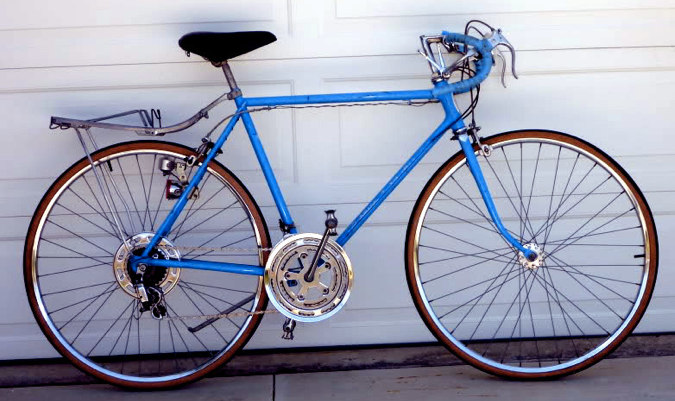
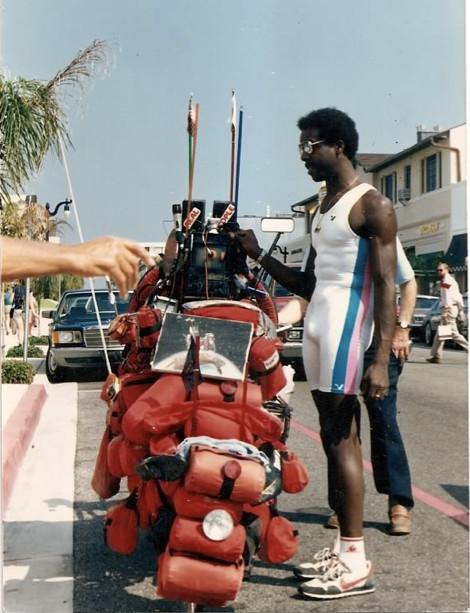
he built a custom bike for his purpose. It was based on a Schwinn Varsity, which was a heavy all-steel ten-speed road bike of the late 1970s, with a one-piece crank.


Schwinn Varsity

In addition to padding the handlebar and adding mirrors, he removed the seat, and put a portable television in its place. He then somehow attached another ten-speed bike to the rear of his bike in order to carry more gear. There is no information as to exactly how the second bike was attached. There are conflicting reports as to how much the entire contraption weighed. The report that I believe says it was 160 lbs (72 kg). Other reports put it at “over 300 pounds” and some say it was 450 lbs.


Wrong Way Wooten and his custom bike

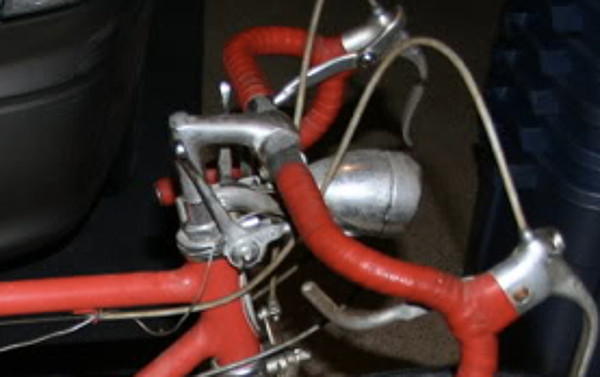
Wrong Way converted the bike to 21 speeds, quite rare in the 1980s, but left the shifters in their original position – on the handlebar stem. This meant that he had to reach between his legs to change gears.


Stem shifters on a Schwinn Varsity

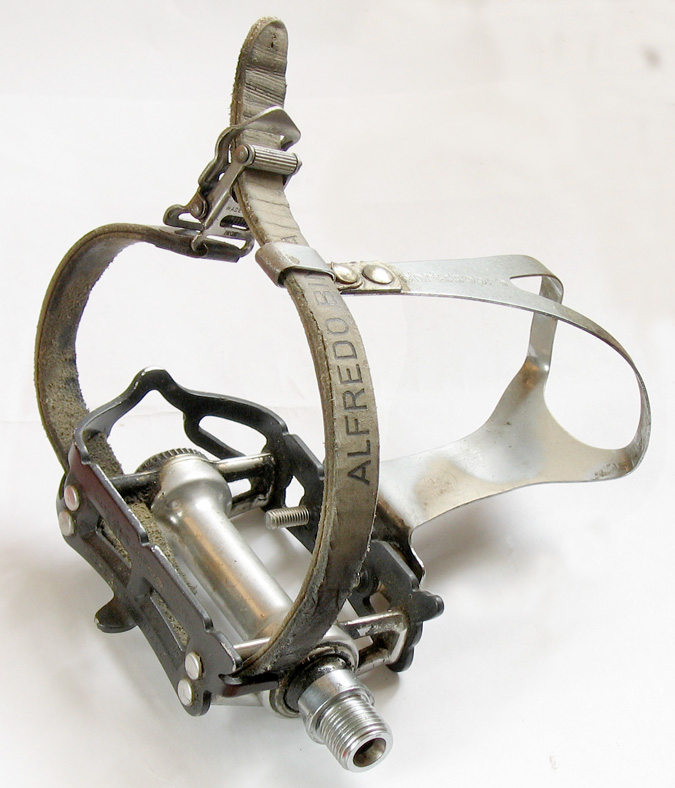
His bike had toe-clips, which were, of course, installed backward on the pedals.


A pedal with toeclip

Before his first trip to traverse the entire United States, he studied maps. Being independently wealthy (according to what little is written – and we don’t know how he attained that wealth, but Bryn Mawr is known for its wealthy residents), he then hired a small airplane to fly low, examining his proposed route for overly steep hills, road construction and other such potential problems.

Wrong Way then set out on his journey with a specific self-appointed mission. He represented several major charities including The American Cancer Society, The American Lung Society, The Heart Fund, the Jaycees, United Way, and March of Dimes, taking donations in person and also encouraging people to donate directly to their favorite charities.

According to the legend, he criss-crossed the country several times totaling 28,000 miles (45,000 kilometers) over the next seventeen years. As he tirelessly explained to thousands of people across the country, “The main reason I do what I do is to get people to realize that they have a responsibility to other people.” When he could, he would ride more than 100 miles in a day, but on many days he couldn’t get that far. This was due to interruptions as fascinated people wanted to talk with him. He was fine with that.

To some, it looked like what he was doing, riding around the country on a bike, would be limitless fun, but he cited some problems, such as flat tires, bad weather and racists who sometimes tried to run him off the road. “I can’t hate them, then I would be just like them.”

Someone once asked what he does when he gets a flat tire. With a straight face he answered, “I set the bike on fire.”

He did not recommend that other people should tour backwards. “One mistake, and you’re history.”

As with all good legends, the stories sometimes exceed the truth. One person remembers that Wrong Way was an expert on the subject of girls. He was supposedly a remarkable cook and a karate expert. That may be true. At least one person says Wrong Way was able to read minds, responding to unvoiced questions. All say he was a brilliant conversationist, able to speak on any level from ghetto talk to erudite conversations with professors.

He has been spoken of as a loner, and in a way, I suppose he was. This was a one-man crusade, and it must have been hard for him to have permanent, deep friendships, since he was always on the move. There is an unverified story that he had a son, who he pretty much entirely neglected. It is reported that this boy had a hard time in school, being an angry, disruptive student.

With the public, he was evidently quite gregarious. On his bike he also carried a sound system, and on more than one occasion he could be seen riding backward, accompanied by blaring music – anything from opera to rock, and sometimes happily singing along.

He planned on riding for twenty-five years. Unfortunately, in 2004, at age 47, he died of a massive heart attack.

His credo was, “Bind yourself to nothing and seek harmony with all things. Only then can you be truly free.” People who remember him say he was a wonderful and very personable ambassador for kindness to others.

For more bicycle information, everything from memoirs to unexpected how-to info, check out the 500 Ways Bicycling section.

Posted on — Leave a comment

Most Embarrassing Way to Treat a Cow

Do not stick your finger in the nose of a cow, unless you are willing to violate one of the rules of the Professional Rodeo Cowboys Association.

Under the Professional Rodeo Cowboys Association (PRCA) rulebook, animal welfare and competition rules strictly regulate how competitors handle livestock. Specifically:

Animal Abuse Regulations: PRCA Rule 9.0 strictly forbids inhumane treatment, abusive handling, or poking sensitive areas of cattle, horses, or bulls. Sticking fingers into an animal’s eyes, ears, or nostrils – whether in the arena or in the chutes – violates animal welfare standards and carries steep fines or disqualification.

Steer Wrestling (Bulldogging): In steer wrestling, where a cowboy leaps from a horse onto a steer’s back to bring it down, the wrestler must use the steer’s horns and neck/jaw for leverage. Using nostrils or the mouth to twist or control the animal’s head is considered an illegal hold.

While the PRCA official rulebook uses broader legal and technical language regarding animal handling and legal wrestling holds rather than the colloquial sentence “Do not stick your finger in the nose of a cow,” doing so does indeed violate PRCA rules.

Posted on — Leave a comment

Worst Disregard for a Free Gift

It is tempting for American kids to drop out of school. Who would want to finish school if their plans are only to build race cars or marry somebody rich? But sometimes plans don’t work out the way you expected. More importantly, in the United States, school is free, supported by taxpayers. It’s free! You might as well take as much as you can get.

More About High School

1. “School spirit” became strongly associated with organized high-school athletics

In the early 20th century, schools increasingly used football games, pep rallies, school colors, songs and mascots to create a sense of community. High school consequently became not just a place for classes, but a miniature social institution.

2. The first U.S. high school was established in Boston in 1821

Boston English High School was created primarily to provide practical education for boys who were not necessarily headed for college. It is still operating today.

3. High school sports helped create some of America’s earliest school mascots

Schools began adopting animals, warriors, and other symbols partly to give students a shared identity at athletic competitions. The mascot could become almost as important to a school’s identity as its name.

4. “Prom” is short for “promenade”

Early American proms were essentially formal dances where students dressed up and socialized. The modern elaborate prom, with expensive dresses, limousines and elaborate “promposals,” evolved considerably later.

5. Some high schools once had rifle teams as ordinary school activities

Marksmanship was offered at many American schools, particularly during the early and mid-20th century. School rifle teams could receive substantial institutional support, especially during periods when military preparedness was emphasized.

6. The SAT has roots in military intelligence testing

The SAT’s ancestry can be traced to standardized tests developed for the U.S. military during World War I. Carl Brigham, who later helped develop the SAT, worked with Army intelligence testing.

7. High-school yearbooks weren’t originally just memory books

Early yearbooks often functioned more like elaborate school records, containing photographs, literary pieces, school history, activities and student organizations. The tradition gradually evolved into the senior-focused yearbook familiar today.

8. “Senioritis” is real as a behavior, but it isn’t a medical disease

The unofficial term describes the tendency of some graduating students to lose motivation once they believe their remaining schoolwork has little effect on their future. The phenomenon has been studied by psychologists under more respectable names such as declining academic motivation.

Posted on — Leave a comment

Worst Bicycle Ergonomics

The worst bicycle ergonomics is surprisingly common. People often ride with their seats too low. This leads to rapid loss of energy, sore muscles and ultimately loss of interest in bicycling.

What is the correct height for your bike seat? You should get almost full extension of your legs at the bottom of the pedaling stroke. Although you normally center the ball of your foot over the axis of the pedal while riding, you can test for proper seat height by leaning against a wall, placing your heels on the pedals, and pedaling slowly backward. Your legs should be just fully extended when your heels are on the pedals.

If it has been a long while since you have ridden and you are somewhat concerned, it is quite OK to set the seat as low as it will go until you are confident again.

Posted on — Leave a comment

Worst Way to Stop a Bicycle

The worst way to stop your bicycle is the way almost everyone does it. They put a foot down on the ground. Instead, you might prefer the ‘invisible kickstand’ trick.

Next time you are waiting at a red light while on your bike, you may want to begin practicing a technique called the ‘track stand.’ As you come to a stop, but before putting a foot on the ground, turn your front wheel about 70 or 80 degrees to the right or left. If your bike is not facing uphill, turn the front wheel facing uphill. This means that your wheel will probably be turned to the left, since most often in non-British countries, the road curves uphill toward the centerline, so that rainwater will run off. Keep steady pressure on one of the pedals, but balance the tendency to roll backward, downhill. With practice, you will find that you can come to a stop and never have to put a foot on the ground. You will be able to rock slightly back and forth, balancing between rolling back and pushing forward.

This trick is used extensively by road racers who don’t want to deal with repositioning a foot on a pedal when it is time to resume riding. For the mountain biker, it helps develop fine control of the bike at slow speeds such as when you are biking along a narrow cliff.

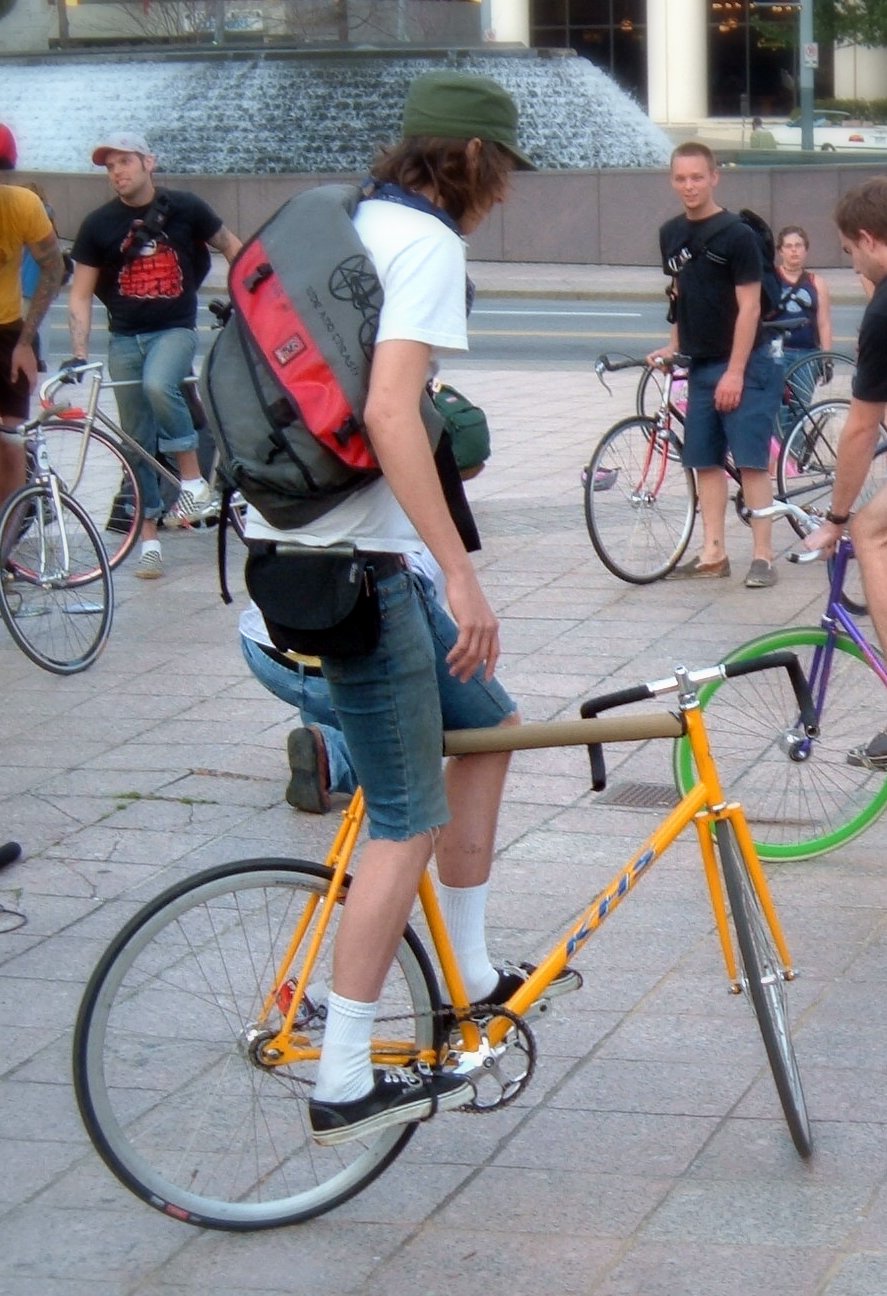
The fellow in the picture above is using a fixed-gear bike (a ‘fixie’) but it can be done on almost any kind of two-wheeled machine. With a fixie, it is not necessary to aim the front wheel uphill.

If you don’t have any slope at all, you can place a hand or foot on the front tire to push the bike backward as needed.

As the guy in the picture illustrates, with practice track stands can be done hands-free.

Posted on — Leave a comment

Worst Bicycling Experience

Some will tell you the worst thing that can happen while riding your bike is being chased by a dog. If that happens, here’s what to do:

1. Slow down or stop. There’s no fun for the dog in chasing something that isn’t moving.

2. In a deep voice, firmly order the dog to “go home.” They often will, but in any case, you’re making it clear who’s in charge and that you do not approve of their current behavior.

3. Get off the bike and place it between you and the dog. It’s a fence to protect you, and if necessary, you can press it against the dog in self-defense.

4. Yell for help. The owner will most likely take control as soon as your plight is discovered.

5. If you encounter the same dog frequently, contact your local animal control agency. In most neighborhoods, it’s illegal to let dogs run loose and bother people.

Posted on — Leave a comment

Worst American Football Tackle

During the 1954 Cotton Bowl on January 1, 1954, Rice University halfback Dickey Maegle (spelled Moegle at the time) took a handoff at his own 5-yard line and sprinted down the right sideline. With no defenders left between him and the end zone, he was on his way to an easy 95-yard touchdown run.

Tommy Lewis, a full-back sitting on the bench for the opposing Alabama Crimson Tide, became so overwhelmed by the moment that he jumped up without his helmet, charged onto the field, and brought Maegle down with a shoulder tackle around Alabama’s 42-yard line before immediately retreating to the bench.

Key details from the legendary play:

The Ruling: The referees invoked the rarely used “Palpably Unfair Act” rule and awarded Maegle the full 95-yard touchdown despite him being tackled short of the end zone.

The Explanation: After returning to the sidelines, a distraught Lewis famously wept and explained, “I guess I’m just too full of ‘Bama.”

The Aftermath: The incident became an instant media sensation. Both players even appeared together on The Ed Sullivan Show a few days later, where Lewis apologized directly to Maegle.

Rice went on to win the game 28–6, but the “12th Man Tackle” remains one of the most famous and unusual plays in college football history.

Posted on — Leave a comment

Worst Small Business Decision

What the Ski Mechanic Did Wrong

Consider one rule which is the most often violated by the people who fail: You must bring in more money than you spend!

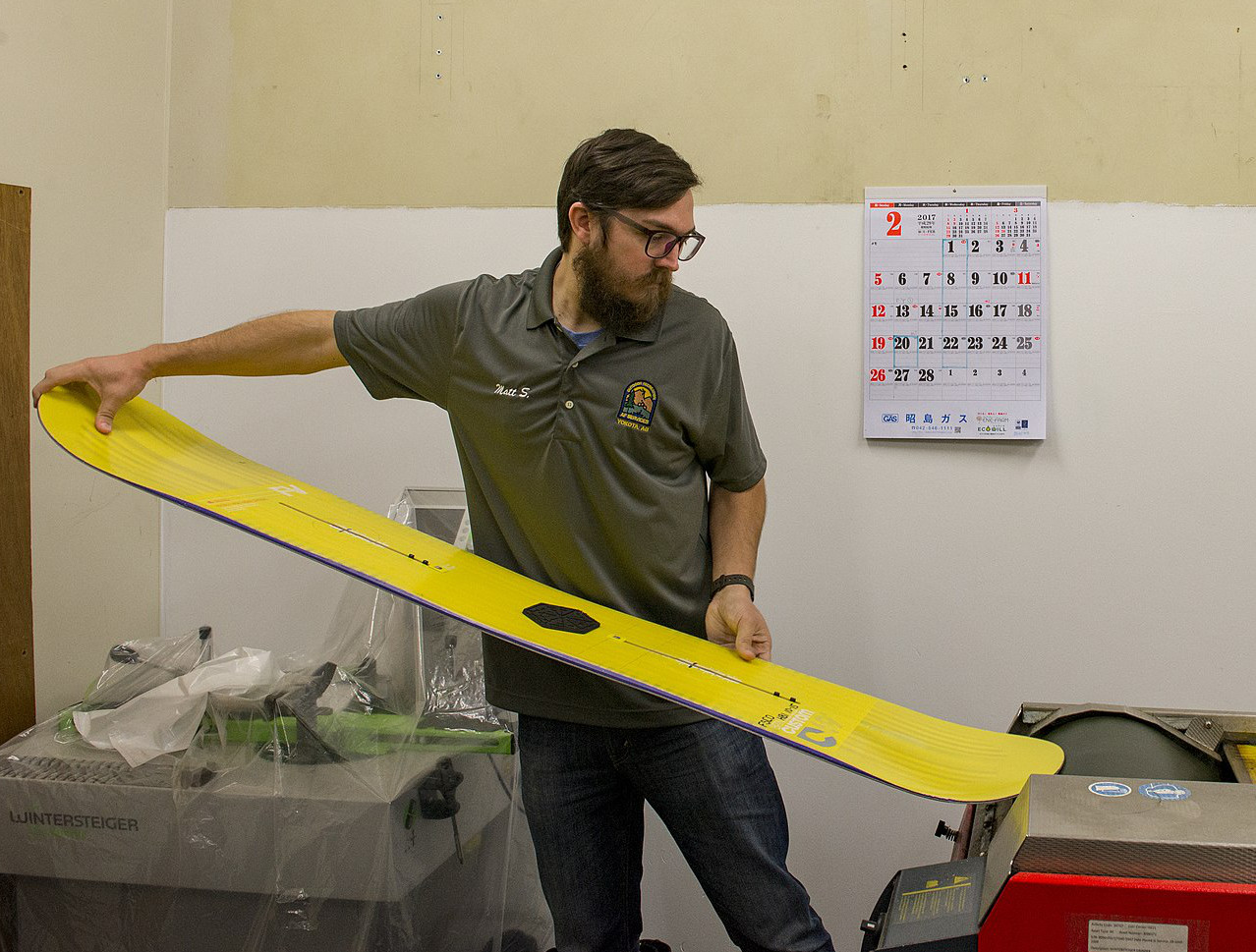
I knew a guy who was an expert ski mechanic. He bought some waxes, some plastic, an iron, some files, all the things he would need. He rented bench space in a store and put up a sign in the store window. Sure enough, skis started coming in. At the end of the first day, he earned $160. Did he spend it on advertising? Or maybe on more materials, or tools to expand his available services? No, he bought himself a pair of fancy cowboy boots and went to a party. His business lasted about a week. When it was time to pay the second week’s bench rent, he didn’t have it! Now that’s just plain bad business! You laugh, but it’s a true story, and variations of it are surprisingly common.

You might enjoy knowing the crazy story of the shop where this happened. It was a bike shop in an eastern city, looking for some kind of business that would bring in people during the winter. The amazing and unexpected true story of that bike shop is here: 5 Years In The Bike Shop.