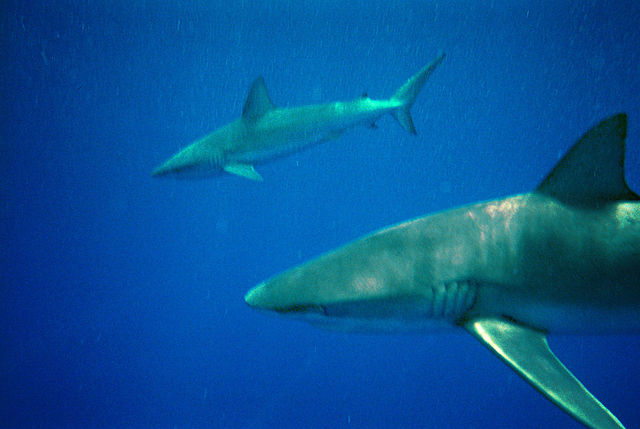
One species of shark is so competitive that the babies fight each other within their mother, until only one is left to be born.
Sharks almost never get cancer. Scientists are studying them to find out why, and whether their protection is adaptable to humans.
Sharks are older than trees.
Sharks have been around for roughly 450 million years, while the first trees appeared about 385 million years ago. Sharks were already swimming in ancient oceans before forests existed.
Some sharks glow in the dark.
Several deep-sea species are bioluminescent or biofluorescent, producing or manipulating light. The cookiecutter shark, for example, has a glowing underside that may help disguise its silhouette from predators below.
Sharks can replace their teeth constantly.
A shark may lose thousands of teeth during its lifetime. New teeth continually move forward from rows behind the functional teeth, creating what amounts to a conveyor belt of dental replacements.
The Greenland shark may live for centuries.
Greenland sharks are among the longest-lived vertebrates known. Scientists have estimated that some can live several hundred years, with one famous estimate suggesting an age of around 400 years.
Sharks can detect electricity.
Special organs called ampullae of Lorenzini allow sharks to detect tiny electrical fields produced by living animals. This can help them locate prey even when it is hidden beneath sand.
A shark’s skin feels like sandpaper.
Shark skin is covered with tiny tooth-like structures called dermal denticles. They make the skin rough and also help reduce drag as the shark moves through water.
Some sharks can walk.
Several species of epaulette shark can use their fins to “walk” across the seafloor and even across shallow exposed areas. They can tolerate remarkably low-oxygen conditions too.
Not all sharks need to keep swimming.
The popular idea that every shark must swim constantly to avoid suffocating is false. Some sharks, such as nurse sharks, can actively pump water over their gills while resting on the seafloor.
The whale shark is a shark, not a whale.
The whale shark is the world’s largest fish and can exceed 40 feet (12 meters). Despite its enormous size, it is a filter feeder that eats plankton and tiny organisms.
Some sharks eat plants.
The bonnethead shark, a small hammerhead relative, has been found to digest and obtain nutrients from seagrass. This makes it one of the few sharks known to have a significant omnivorous diet.