Posted on — Leave a comment

Most Extreme Duplication

More than two and a half billion Bibles have been made. If you put them on a long bookshelf and started driving along the shelf at 65 mph (104 kph), you would have to drive 40 hours per week for four months to get to the end. All these Bibles would fill the New York public library 467 and one-half times.

A typical Bible contains 3,566,480 letters, or 810,697 words.

One of the first-ever printed books was the Bible, pressed by Johannes Gutenburg in Germany around the year 1450. Only 49 complete or nearly complete copies remain.

Pictured above: A Gutenberg Bible, one of the first-ever printed books.

Posted on — Leave a comment

Worst Sentence

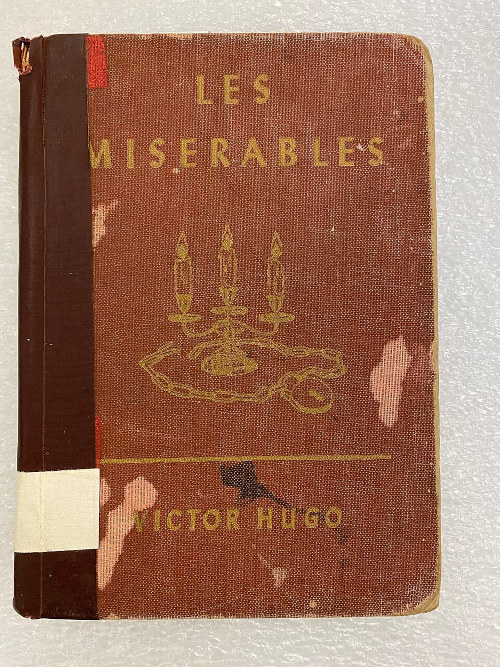
In the book, Les Miserables by Victor Hugo, is one sentence that is 823 words long. When Vic wrote to his editor inquiring about their opinion of the manuscript, he wrote, “?” They answered, “!”

“The famous 823-word sentence in Victor Hugo’s Les Misérables appears in Volume 4 (“Saint-Denis”), Book 1, Chapter 3, in which Hugo gives a sprawling, exhaustive character portrait of King Louis Philippe. In Isabel F. Hapgood’s classic English translation, the sentence reads as follows:

“The son of a father to whom history will accord certain attenuating circumstances, but also as worthy of esteem as that father had been of blame; possessing all private virtues and many public virtues; careful of his health, of his fortune, of his person, of his affairs, knowing the value of a minute and not always the value of a year; temperate, serene, peaceful, patient; a good man and a good prince; sleeping with his wife, and having in his palace servants whose business it was to show the conjugal bed to the bourgeois, an ostentation of regular domestic life which had become useful after the faux pas of the elder branch; knowing all the languages of Europe, and, what is rarer, all the languages of all interests, and speaking them; an admirable representative of the ‘middle class,’ but outstripping it, and in every way greater than it; possessing excellent sense, while appreciating the literature which instructed him, scoffing at genius; an authority on weapons, a good doctor, a good farmer; a friend of the shopkeeper, but not of the courtier; a man of the world, and a gentleman, but not a courtier; possessing an infinity of small qualities, but few great ones; an administrator rather than a king; reading everything, writing everything, estimating everything, calculating everything, looking into everything, neglecting nothing, never taking a step without consulting his own conscience, but always in a manner that was agreeable to himself; having a supreme respect for the law, but an equal respect for his own interest, and knowing how to make the law serve his interest, or his interest serve the law; a good husband, a good father, a good master, a good neighbor; a good judge, but a bad executioner; a good administrator, but a bad strategist; a good citizen, but a bad soldier; a good king, but a bad hero; having the spirit of his times, but lacking its heart; loving peace, but preferring tranquility; preferring the useful to the agreeable, and the agreeable to the sublime; a man whom history will accuse of having been too prudent, but whom humanity will pardon for having been too gentle; having the art of making himself loved without making himself feared; possessing a great deal of charm, but little majesty; a man of compromise, but not of weak compromises; having a great deal of wisdom, but no genius; an excellent politician, but a bad statesman; an indefatigable worker, but a bad guide; always ready to risk his life, never his work; disguising his will in influence, in order that he might be obeyed as an intelligence rather than as a king; endowed with a marvelous faculty for turning everything into success, and with a disposition which has this unfortunate property, that as it turns everything to success, it admits of ruse and does not absolutely repudiate baseness, but which has this valuable side, that it preserves the state from violent shocks, the people from terrible crises, and society from fatal revolutions; incontestably fond of his country, but preferring his family; assuming more domination than authority and more authority than dignity; brave as a grenadier, courageous as a thinker; uneasy only in the face of the chances of a European shaking up, and unfitted for great political adventures; having a great deal of tact, but little greatness; a man, in short, who had forgotten nothing, and who had learned nothing; a mind without a horizon, but a heart without a stain; a prince, in fine, who was the very type of the constitutional monarch, and whose reign was the most complete, the most calm, the most prosperous, and the most happy that France had ever known, and who, if he had been able to add to all these qualities a little of the enthusiasm of 1789, would have been the greatest ruler that France had ever seen.”

Posted on — Leave a comment

Worst Book

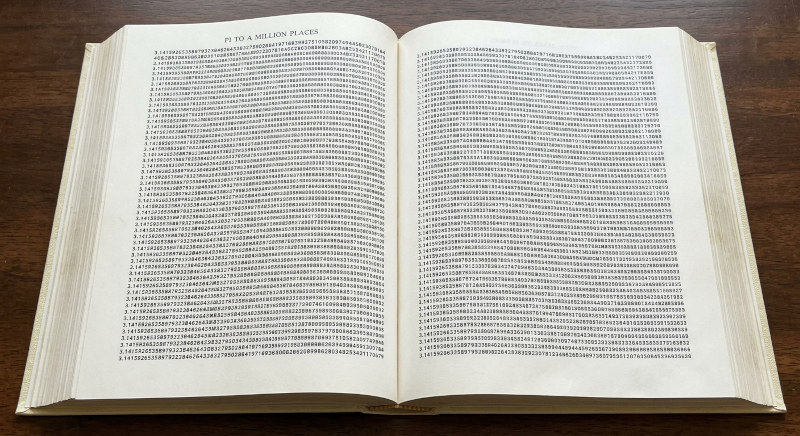
Perhaps the most uninteresting book ever written is the calculation of pi to two million places, in 800 pages. Just think of the TV special that could be made from this book.

Weird Facts About Pi

  • It Has Its Own Secret Language

    There is a dialect of constrained writing called “Pilish,” where the length of consecutive words corresponds to the digits of π. For example, “How I need a drink, alcoholic of course…” matches 3–1–4–1–5–9–2–6. Author Mike Keith wrote an entire 10,000-word novel titled Not A Wake written completely in Pilish.

  • NASA Only Uses 15 Digits for Space Travel

    Despite supercomputers calculating π to tens of trillions of digits, NASA only uses 15 decimal places (3.141592653589793) for interplanetary navigation. Using 15 digits gives them enough precision to calculate the circumference of a circle 78 billion miles wide (about 16 times the distance from the Earth to Pluto) with an error no larger than the width of a human index finger.

  • The Mirror Trick Spells Food

    If you write out the first three digits of π (3.14) on a piece of paper and hold it up to a mirror, the reflected image spells out the word “PIE”.

  • An Indiana Law Almost Changed Its Value

    In 1897, a physician named Edward J. Goodwin introduced Indiana House Bill No. 246, claiming he had discovered a way to “square the circle”. The mathematical implications of his complex method would have legally set the value of π to approximately 3.2. The bill actually passed the state House of Representatives before a university math professor intervened, causing the state Senate to postpone the bill indefinitely.

  • A Tombstone Showing Off Pi

    Dutch-German mathematician Ludolph van Ceulen devoted a huge portion of his life in the late 16th century calculating π to 35 decimal places. He was so proud of the accomplishment that he had the numbers engraved on his tombstone in Leiden, Netherlands. In Germany, π was historically referred to as the “Ludolphine number” in his honor.

  • It Makes Squaring the Circle Impossible

    Because π is a transcendental number (it is not the root of any non-zero polynomial equation with rational coefficients), it was proven in 1882 that “squaring the circle”—constructing a square with the exact same area as a given circle using only a straightedge and compass—is mathematically impossible.

  • Albert Einstein and Stephen Hawking Share Pi Day

    Pi Day is celebrated on March 14 (3/14). Albert Einstein was born on Pi Day in 1879. Coincidentally, famed theoretical physicist Stephen Hawking died on Pi Day in 2018.

  • It Shows Up in Wave Mechanics and Probability

    Although most people first learn about π in geometry, it appears in areas of math that have no obvious circles. For instance, in Buffon’s Needle Problem, if you drop a needle onto a floor lined with parallel strips of wood, the probability that the needle will cross one of the lines is directly related to π. It also shows up constantly in quantum mechanics, wave frequencies, and signal processing.

  • The Human Memorization Record Exceeds 70,000 Digits

    The official Guinness World Record for memorizing and reciting digits of π belongs to Rajveer Meena of India, who recited 70,000 decimal places from memory on March 21, 2015. The feat took him roughly 10 hours while blindfolded.

  • A Single Mistake Ruined 20 Years of Hand Calculations

    In 1873, English mathematician William Shanks announced he had calculated π to 707 decimal places entirely by hand. It stood as the record for over 70 years until 1944, when another mathematician discovered that Shanks had made an error on the 527th digit. Because the calculation relied on earlier values, every digit he calculated after the 526th was completely wrong!

Posted on — Leave a comment

Worst Thing to do About the Game of Chess

Do not write another book about chess. More than 35,000 books have been written about the game so far.

More Unexpected Info About Chess

The Queen Was Once the Weakest Piece

When chess was first created, the queen could only move one square diagonally at a time. It wasn’t until around the late 15th century—partly influenced by the rise of powerful European monarchs like Queen Isabella I of Spain—that the queen gained her modern, multi-directional powers to become the most lethal piece on the board.

The “Turk” Hoax Fooled the World for Decades

In 1770, an inventor named Wolfgang von Kempelen unveiled “The Turk,” a mechanical automaton that could play chess against human opponents. It famously defeated figures like Napoleon Bonaparte and Benjamin Franklin. Decades later, it was revealed to be a complete hoax: a human chess master was hiding inside the cabinet using a complex system of levers and magnets to control the automaton’s arm.

There are More Possible Games Than Atoms in the Universe

The total number of possible unique chess games is estimated at around 10¹²⁰ (known as Shannon’s number). By comparison, the observable universe contains roughly 10⁸⁰ total atoms, meaning there are vastly more ways a chess game can play out than physical particles in existence.

Folding Boards Were Invented to Disguise the Game as Books

In 1125, a priest wanted to play chess despite a church ban on the game. To bypass the rule, he designed a folding chessboard that, when closed and placed on a shelf, looked like two books sitting side by side.

A Player Once Spent 2+ Hours Thinking About One Early Move

Before strict modern chess clocks were enforced, players could take as long as they wanted per turn. In a 1980 match, Brazilian International Master Francisco Trois spent 2 hours and 20 minutes deciding on his 7th move—only to later admit he couldn’t explain why he hesitated so long over just two basic options!

“Checkmate” Literally Means “The King is Helpless”

The word checkmate comes from the Persian phrase “Shāh Māt”. While many people translate it as “the king is dead,” it actually translates closer to “the king is left helpless” or “the king has been paralyzed,” as the king piece is technically never captured or killed on the board.

The Longest Official Game Took 269 Moves and Over 20 Hours

The record for the longest grandmaster game ever played in an official tournament belongs to Ivan Nikolić and Goran Arsović in Belgrade, 1989. The grueling match lasted 269 moves, took over 20 hours to complete, and ultimately ended in a draw.

Rookies Get Their Name From Chess

The slang word “rookie”—meaning a beginner, newcomer, or first-year athlete—is widely believed to trace its roots back to the Rook. Because rooks are usually the last major pieces to be moved out into action during a game’s opening phase, they were colloquially associated with latecomers or new entrants.

The Second Book Ever Printed in English Was About Chess

Shortly after Johannes Gutenberg introduced the printing press, William Caxton printed The Game and Playe of Chesse in the 1470s. It was only the second book ever published in the English language.

A Grandmaster Once Played 604 Games at the Same Time

In 2011, Iranian Grandmaster Ehsan Ghaem-Maghami set a record by playing 604 simultaneous games of chess over a 25-hour marathon. Walking continuously from board to board, he won 580 of the matches, drew 16, and lost only 8.

Posted on — Leave a comment

Worst Way to Write a Book

In 1939 an author named Ernest Vincent Wright wrote a 50,000 word novel called Gadsby. The only thing unusual about the novel is that there is not a single letter e in the whole thing.

Why Did He Write It?

To Prove Critics Wrong: Wright was inspired after discovering that “e” is the most frequently used letter in English (occurring roughly five times more often than any other letter). When he brought up the idea of writing a book without it, colleagues told him it was impossible to accomplish without writing complete nonsense or breaking basic rules of grammar. He took on the challenge specifically to prove it could be done.

As a Technical “Lipogram” Challenge: Wright wanted to test the flexibility of the English language. A work written while deliberately omitting a specific letter or group of letters is known as a lipogram.

How He Pulled It Off

Physical Constraint: To avoid typing the letter by accident, Wright physically tied down the “E” key on his typewriter so it couldn’t strike the ribbon.

Grammatical Hurdles: Omitting “e” meant he could not use common pronouns (he, she, they, them, it), articles (the), or standard past-tense verbs ending in -ed.

Creative Substitutions: He had to heavily alter vocabulary and phrasing—for instance, changing famous quotes like “A thing of beauty is a joy forever” to “A charming thing is a joy always.”

Was it a Popular Book?

When it was first published, Gadsby was an absolute commercial and critical flop, though it eventually became a famous cult curiosity and rare book collector’s item.
Initial Reception & Sales

Rejected by Traditional Publishers: Wright spent over two years trying to find a mainstream publisher, but none would take it. He ultimately had to pay a vanity press (Wetzel Publishing Co.) in Los Angeles to print it in 1939.

Virtually Ignored: The book received almost no attention or serious literary reviews upon release. The public had little interest in reading a story whose primary selling point was an awkward constraint.

Tragic Timing: Wright died in October 1939 at the age of 66—just months after the book was printed—and never saw his work gain any recognition.

The Warehouse Fire

Shortly after the book was printed, a fire broke out at the publisher’s warehouse, destroying most of the unsold stock. Because the original print run was already very small and few copies were sold prior to the fire, surviving first-edition physical copies became extremely scarce.
Modern Cult Status

While it was a commercial failure in 1939, Gadsby gained a legendary reputation in niche literary circles decades later:

Literary Curiosity: It became famous among word-game enthusiasts, lexicographers, and fans of “constrained writing” (lipograms).

Collector’s Item: Because so few copies survived the warehouse fire, original first editions of Gadsby are highly valuable, with rare copies selling anywhere from $4,000 to $9,000+ depending on condition and whether they retain the original dust jacket.

Public Domain Classic: Since the copyright was not renewed, the text entered the public domain and is now widely available to read online for free.

The Author

In addition to writing several books, Ernest Vincent Wright was a dance instructor, musician, typewriter salesman, and newspaper editor.

The First Two Paragraphs

Here are the first two paragraphs of Chapter 1 of Gadsby by Ernest Vincent Wright:

“If Youth, throughout all history, had had a champion to stand up for it; to show a doubting world that a child can think; and, possibly, do it practically; you wouldn’t constantly run across folks today who claim that ‘a child don’t know anything.’ A child’s brain starts functioning at birth; and has, amongst its many faculties, an ability to assimilative thought.

Up to about its primary school days a child thinks, naturally, only of play. But many a form of play contains disciplinary factors. ‘You can’t do this,’ or ‘that puts you out,’ shows a child that it must think, practically, or fail. Now, if, throughout childhood, a brain has no opposition, it is plain that it will attain a position of ‘status quo,’ as with our ordinary animals. Man knows not why a cow, dog or lion was not born with a brain on a par with ours; why such animals cannot add, subtract, or obtain from books and schooling, that paramount position which Man holds today.”

Posted on — Leave a comment

25 Worst Place Names

Here are Some American Communities with the Worst Names

Truth or Consequences, New Mexico

Experiment, Georgia

Don’t Handle the Bobcats Without Gloves, Texas

Mars, Pennsylvania

Embarrass, Wisconsin

Mexican Hat, Utah

Enigma, Georgia

Old Joe, Arkansas

Smackover, Arkansas

Kissimme, Florida

Social Circle, Georgia

Waterproof, Louisiana

Why, Arizona

Zigzag, Oregon

Talent, Oregon

Zyxyz, California

Hygiene, Colorado

Imalone, Wisconsin

Gnaw Bone, Indiana

Bunlevel, North Carolina

What Cheer, Iowa

Humptulips, Washington

Scalp Level, Pennsylvania

Cheesequake, New Jersey

Looneyville, West Virginia

Monkey’s Eyebrow, Kentucky