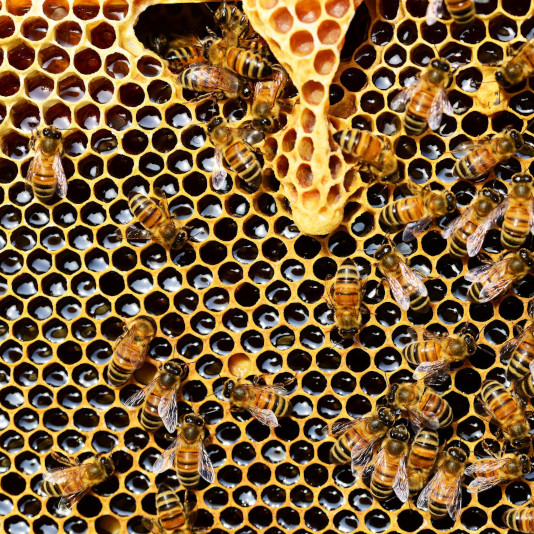
Bees have to fly a total of 50,000 miles (80,000 km) to gather enough honey for one 16-ounce (1/2-liter) jar.
10 Fascinating Honeybee Facts
- The Waggle Dance: Bees communicate the exact direction, distance, and quality of food sources to their hive mates by performing a figure-eight “waggle dance” inside the dark hive.
- Hexagonal Efficiency: Honeycombs are built using precise hexagonal geometry, which provides the maximum volume of storage while using the minimum amount of wax structural support.
- Cold Weather Heating: Honeybees don’t hibernate in winter. Instead, they form a tight cluster around the queen and vibrate their wing muscles to keep the center of the swarm at a steady 93°F (34°C).
- Superhuman Vision: Bees see colors in the ultraviolet spectrum, allowing them to spot hidden “bullseye” patterns on flower petals that point directly to nectar deposits.
- Distinct Caste Roles: A worker bee’s job changes with age: she starts as a cleaner, moves on to nursery care and comb building, guards the hive entrance, and finally becomes a field speller/forager.
- Royal Jelly Transformation: Any female bee larvae can become a queen; potential queens are fed exclusively on a nutrient-rich substance called “royal jelly,” which triggers the development of their reproductive organs.
- Extreme Speed & Wing Beats: A honeybee flaps its wings roughly 230 times per second, creating their characteristic buzz, and can fly at speeds up to 15 to 20 miles per hour.
- Short-Lived Males: Male bees (drones) exist solely to mate with a queen from another hive. They have no stingers, do not forage, and are kicked out of the hive to starve before winter to conserve stores.
- Complex Brain Navigation: Despite having a brain the size of a sesame seed, honeybees can navigate using the sun as a compass, even on overcast days, by detecting polarized light.
- Endless Shelf Life: Honey is so low in moisture and high in acidity that bacteria and micro-organisms cannot grow in it. Sealed honey found in ancient Egyptian tombs remains completely edible after thousands of years.
The waggle dance has been fully decoded.
Austrian ethologist Karl von Frisch first decoded the meaning of the dance in the 1940s. His breakthrough proved that bees use a symbolic language to communicate precise coordinates, earning him the Nobel Prize in Physiology or Medicine in 1973.
The dance functions as a polar coordinate map that breaks down into three key elements:
- Direction (The Angle): The angle of the bee’s straight “waggle run” relative to vertical gravity matches the exact angle between the sun’s position and the food source outdoors.
- Distance (The Duration): The length of time the bee waggles her abdomen during the straight run communicates the distance. Roughly 1 second of waggling equals about 750 meters (nearly half a mile).
- Quality (The Intensity): The vigor and repetition rate of the dance signal the richness and sugar concentration of the nectar.
Modern Advances in Decoding
In recent years, researchers at institutions like Sussex University and Virginia Tech have refined von Frisch’s work. By using high-speed cameras, AI computer vision, and machine learning models, scientists can now automatically decode thousands of dances in real-time.
Ecologists use decoded dances as biological monitoring tools, mapping where bees forage across different seasons to identify nectar shortages and decide where to plant more flowers to support declining pollinator populations.